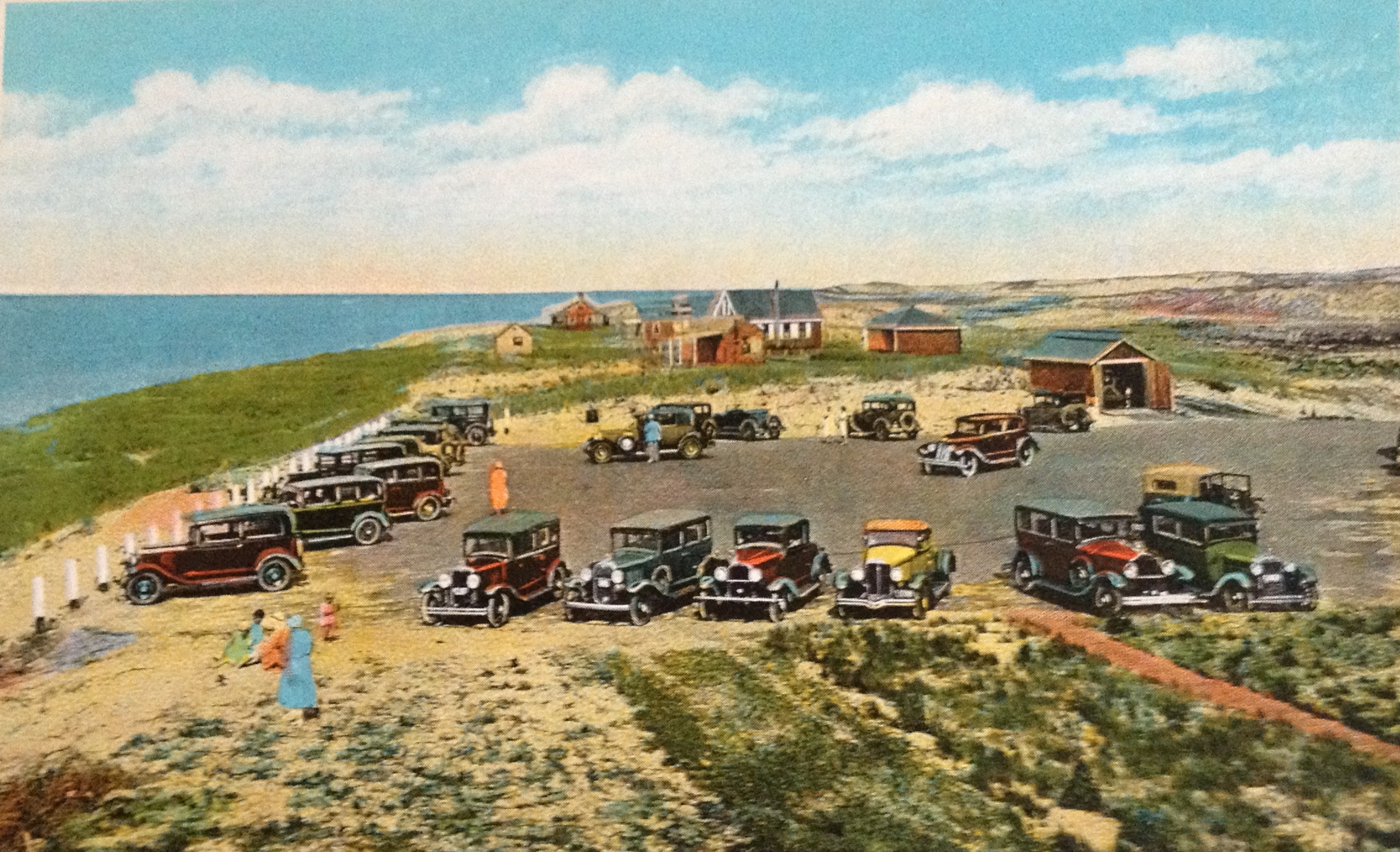
In 1910, the automobile was still a relatively new luxury form of transportation. If you owned one, it was a treat to take a driving tour out to the very end of Cape Cod and visit the beaches, sand dunes, and town of Provincetown. This antique postcard shows the parking lot of the Race Point Coast Guard Station (now part of the National Seashore) on a clear sunny day with all of its original buildings. It’s still a great place to visit today, and summer is almost here. Want to get in the mood for your visit? Read the new novel, Remaining in Provincetown by S.N. Cook now available online and in bookstores and at Amazon.com in trade paperback and on kindle. Like us on Facebook.
Tag Archives: antique postcards
Provincetown Cape Cod setting for mystery and love
The above antique postcard shows the beauty of the Provincetown shoreline, viewing it from the harbor. While fishing boats are fewer, the beauty of the Cape Cod town known for its art galleries, bars, restaurants, and shops has gone through many evolutions through the decades, but is still a compelling place. As described in the new murder mystery Remaining in Provincetown by S.N. Cook, “Whatever their disagreements, members of the Provincetown community were united in their love of the sea and sand dunes, along with the winding, narrow streets and nineteenth century architecture that dominated this small New England town.” Want to read more? The 306 page paperback is available at a number of online sites and at bookstores including Amazon.com and is also available as an ebook on kindle. Don’t forget to like us on facebook. We’ll be giving away one more FREE book this week to a facebook fan.
Provincetown Cape Cod East End Vintage Postcard
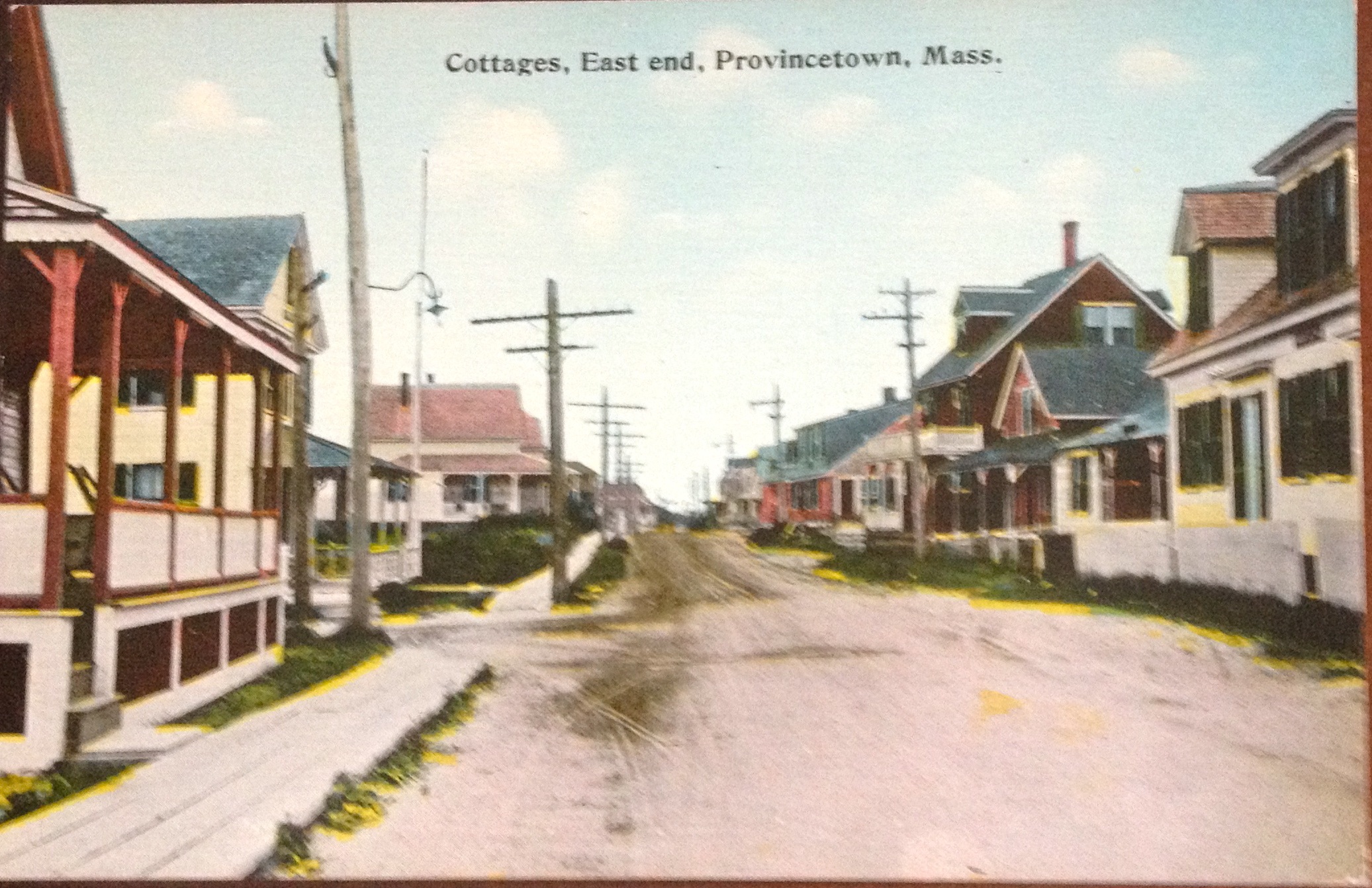
Provincetown’s Commercial Street is unpaved and the sidewalks are made of wood, but the houses look very much the same as they do today. in this antique postcard printed 100 years ago.
Every town has its East End and West End and Provincetown, with its long and narrow in configuration, is no different. The East End on the waterside has traditionally been populated with seasonal summer residents. Famous artists like Robert Motherwell and Helen Frankenthaler constructed a grand residence on the East End waterfront, but others of more modest means stayed in historic Cape Cod cottages. Empty lots are few and far between, when waterfront land is so valuable, but take a walk at the start of town, at the point where Commercial Street and Bradford Street divide, and see many beautiful old homes, primarily built in the beginning of the 20th century. What kinds of houses do the characters in Remaining in Provincetown live in? Real estate speculation has played a major role in Cape Cod’s economic development and where there is money to be made there is often graft and corruption. Could that kind of corruption lead to murder? You’ll have to read the book to find out. Now available at Amazon in trade paperback or on kindle as an ebook. Like us on Facebook and be entered to win a FREE book and thank you for all the positive feedback
Provincetown Gay Party Central, Crown & Anchor history

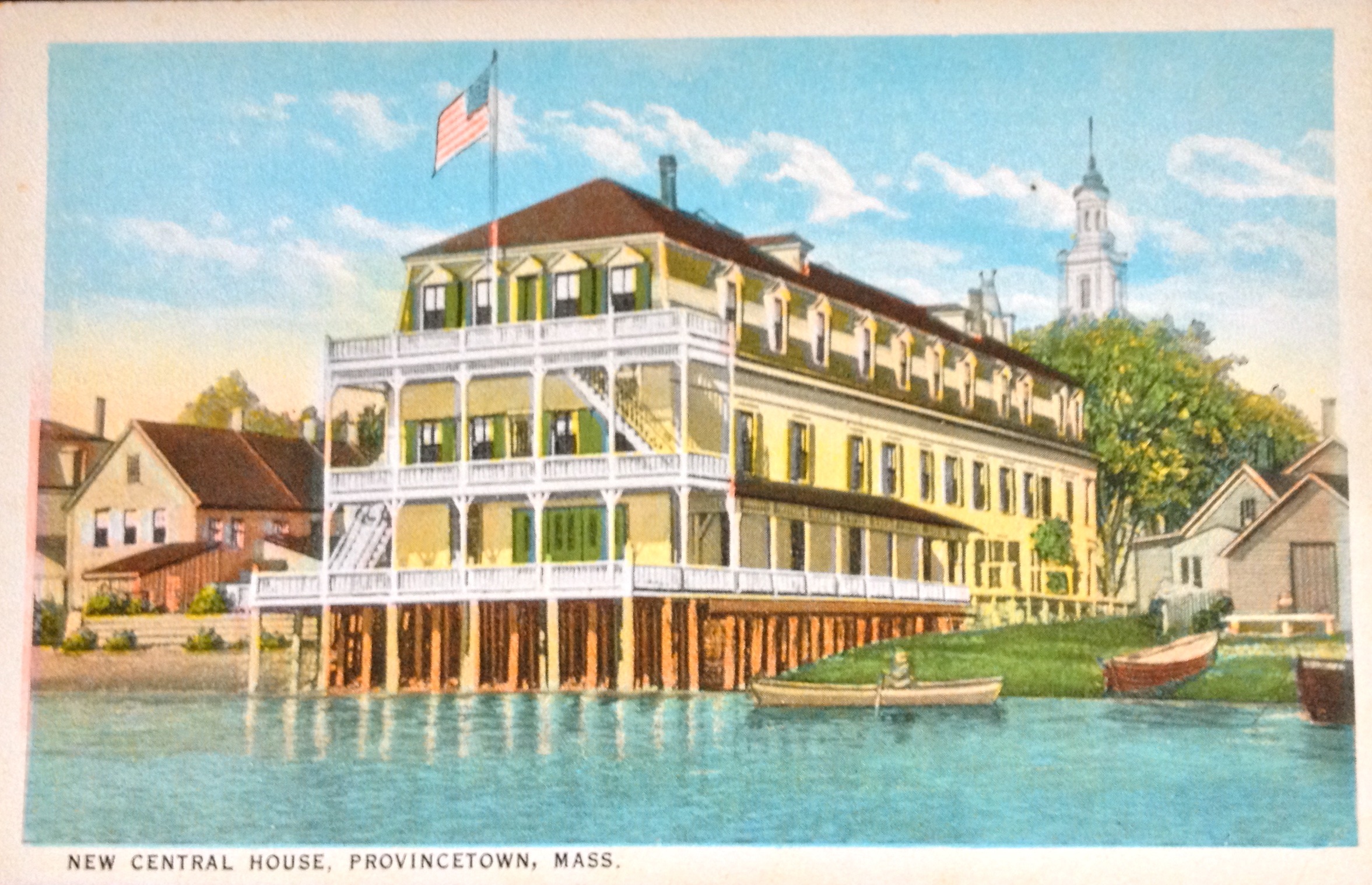
Now called The Crown & Anchor, the New Central House was a popular Provincetown Inn in the 19th century and today is a “happening place”.
The handsome waterfront Provincetown Inn located in the center of Provincetown on Commercial Street has gone by many names. In the antique postcard shown above it is called “New Central House”. Said to have been built in 1836 as the Central Hotel by 1868 it was considered the largest hotel at the tip of Cape Cod, with 75 guest rooms. A private beach with cabanas and long porches with rocking chairs for guests to sit out and look at the water, made this Inn a successful business that kept expanding through its many incarnations. Its been called: Ocean House, Central House, New Central House, Towne House, the Sea Horse Inn. and the Crown & Anchor as it is known today. At the end of the 19th century it catered to prosperous guests by providing a billiard hall, smoking rooms, gentleman’s parlor, and ladies’ reading room for a mixed clientele of families and primarily straight travelers. But as the town evolved into a mecca for gay travelers, it gradually evolved into a thriving complex of bars and restaurants that cater to gay and lesbian patrons of varying tastes. Although the Crown & Anchor was burned to the ground in 1998 when adjacent Whaler’s Wharf burned as well, it was faithfully rebuilt in its previous architectural style. The leather bar is known as The Vault and the restaurant Central House at the Crown pays tribute to its earlier years by using the earlier name of the hotel. while the Paramount Nightclub, Piano Bar, Wave Video Bar and more make certain there is always a party going on somewhere. Places to have a good time are an important aspect of life in Provincetown, whether you are a tourist or a resident, and in the new mystery novel Remaining in Provincetown a popular hang-out is the fictitious “Cowboy Club”. Want to learn more about what goes on there? You’ll have to read the book now available at Amazon.com and as an ebook on Kindle. Like our Facebook page and you may win a FREE copy.
Provincetown Inn mystery of the house on the hill
Today a contemporary mansion, once the residence of the famous psychologist Carl Murchison, sits high up looking out across Land’s End, hidden by an overgrown thicket of shrubs and trees across the street from the Provincetown Inn. But 100 years ago, as shown in the above picture postcard, a white Victorian style house sat on an open bluff and the Provincetown Inn was yet to be constructed. (They opened their doors in 1925).
Cranberry bogs and wetlands once were more apparent in this scenic spot on the very tip of Cape Cod and an open white fence created a boundary for the flower bed and green fields beyond. Sidewalks were made of wood.
So who was Carl Murchison and his wife Dorotea who built the current glass walled house that sits on the hill today?… The Murchisons moved to Provincetown in the mid 1930s from Worcester, Massachusetts where Carl was previously editor and publisher of the Clark University Press. Chair of the psychology department at Clark University he edited over a dozen books which brought international recognition to the University but also created some controversy within some scientific circles as to his research practices and management of the psychology department. In 1935 he founded the Journal of Psychology, which he published out of his own home. This newest enterprise created the ultimate clash leading to his exit from the University. He did, however retain possession of all the Clark University Press journals he edited and he continued to publish his journals out of Provincetown. A tragic fire in the spring of 1956 destroyed the original house, including many of his private papers. A new modern house designed by Walter Gropius’s firm, costing $300,000 (a princely sum at the time) replaced the earlier home but unfortunately Carl did not live very much longer to enjoy its beauty. ( It was named on of the best-designed homes at 1959 by Architectural Record magazine. )He died in 1961, after an 18 month illness, (For more details about Murchison’s life consult Portraits of Pioneers in Psychology, vol 2, edited by Kimble, Boneau & Wertheimer, and published by the American Psychological Association, 1996.) His wife lived in the house for another 20 years. If you like mysteries and you like Provincetown, you’ll want to read the new novel Remaining in Provincetown, just released this month and available for sale at Amazon in trade paperback or kindle. Like our Facebook page and you may be selected to receive a FREE book.
Provincetown Harbor Prettiest on Cape Cod

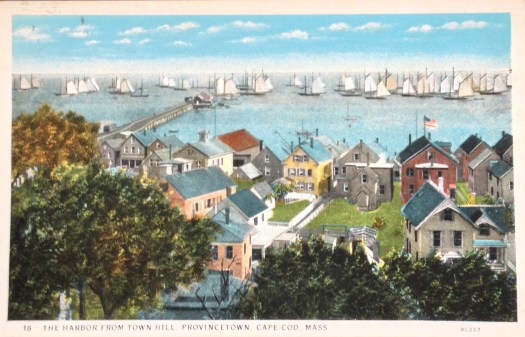
A view of Provincetown, Massachusetts harbor from Town Hill.
An antique postcard from the time when it only cost one penny to mail, this color lithographic print captures the beauty of Provincetown on the tip of Cape Cod when the harbor was filled with sailing ships. The description on the back says it all: PROVINCETOWN is one of the quaintest places, not only on the Cape, but in the entire country with its old streets, very narrow at that, and fairly teems with “local color” which attracts scores of artists every year eager to transfer the odd scenes to canvas. It is entirely unlike any other town in the country and must be seen to be fully appreciated. Writers are also artists, and the town is certainly the inspiration for the just released murder mystery Remaining in Provincetown now available at Amazon.com and on Kindle. Like the RemaininginProvincetown Facebook page and you may be selected to win a FREE book.
Finback Whale watching in Provincetown Cape Cod
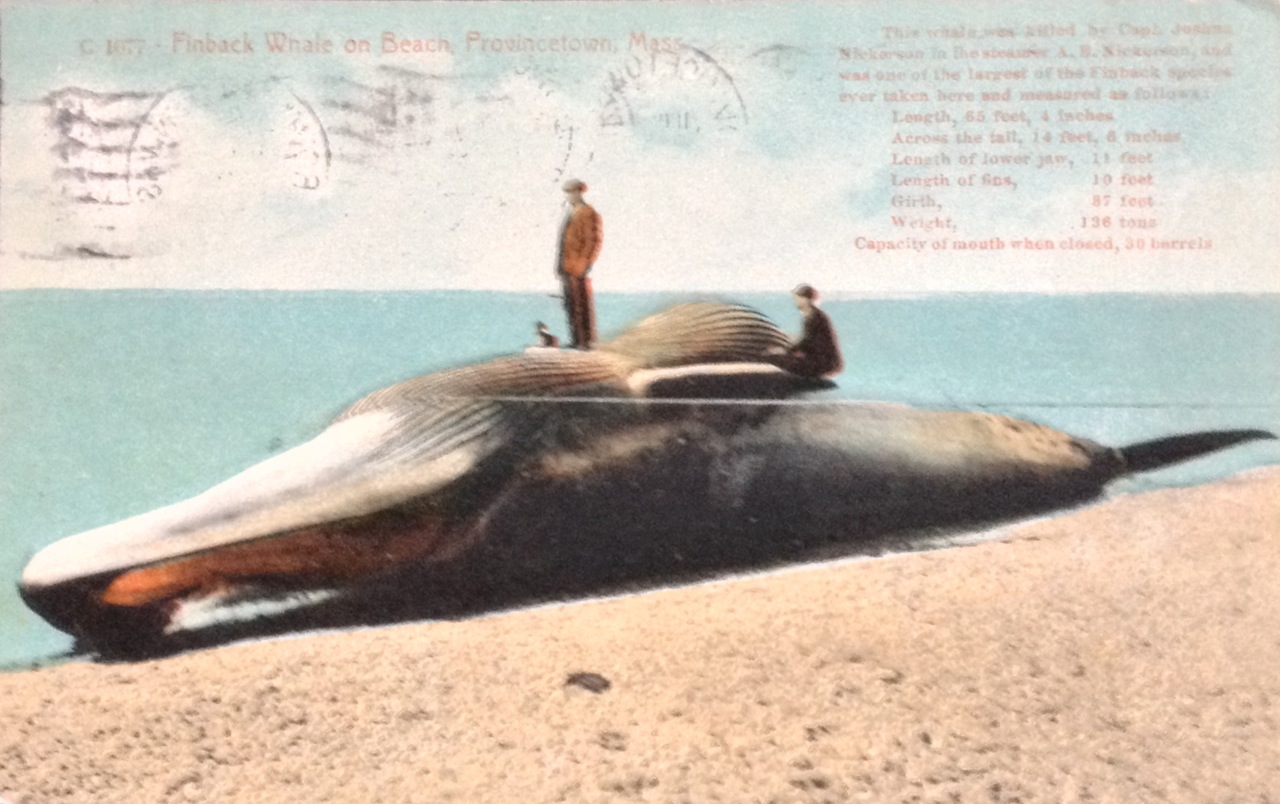
The Finback whale shown in this antique postcard which was mailed in 1918, at first glance looks as if it beached on the Provincetown shore. But on closer examination, and from reading the caption on the photograph, the sad truth is this whale was hunted and killed for its blubber oil. Currently an endangered species, the Finback is the second largest animal in the world. (The Blue Whale is the largest) It has been described by naturalist Roy Chapman Andrews as “the greyhound of the sea”. Since the mid 1980’s whale watching has become a way for visitors to Cape Cod to observe these handsome mammals. Often sighted in the waters on the tip of Cape Cod are primarily Humpback Whales as well as a few Finback Whales.
This particular whale in the vintage postcard above was killed by Captain Joshua Nickerson while at the command of the steamer the A.B. Nickerson. It was one of the largest of the Finback species ever taken in Provincetown and measured 65 feet and 4 inches in length and weighed 136 tons. According to the book Provincetown written by Herman Atwell Jennings, “in 1886 the steamer and a facility for processing whales was built at Herring Cove near the Race Point Lighthouse and in 1889 a wharf was extended from shore four hundred feet to enable the factory steamer to bring the whales and other fish alongside to be handled.” A number of the streets in Provincetown have the names of the early families that include Nickerson, Snow, and Dyer. Small towns have their secrets. Want to gain a more intimate sense of the town and its inhabitants? You’ll want to read the new novel Remaining in Provincetown, now available at Amazon.com. Like us on Facebook and you may win a FREE copy.
Provincetown ferry to Boston living history
The “Boston Boat” has been a fixture in Provincetown culture since the first ferry boat connected the city of Boston to the furthermost tip of Cape Cod in 1883. The first boat was named The Longfellow and it was replaced in 1911 by the Dorothy Bradford shown above docking at Railroad Pier, now known as MacMillan Pier (named for the famous arctic explorer). Operated by the Cape Cod Steamship Company, the Dorothy Bradford was in service until 1937. Today seasonal ferry service between Boston and Provincetown is provided by the Bay State Cruise Company. The Provincetown III makes it possible to get from Boston to Provincetown in just 90 minutes. The 2013 season begins on May 17th and will operate until mid October. For a lower price on Saturdays, visitors can take the Provincetown II for a lower price and a slower three hour journey. Either way, approaching Cape Cod by water provides beautiful scenery on a clear day. And it’s the beautiful scenery and the proximity to water that has the characters in Remaining in Provincetown so committed to the town, despite its seasonal economic challenges. What is it like to live in the town when the “Boston Boat” is not running and tourists are few? You’ll have to read the book , now available at Amazon.com, to find out.
Gay Provincetown friendly to pets
Is this young lady saying she has no chance in Provincetown because none of the men in town are interested in her or because she is walking with a dog? When did Provincetown first get its reputation as a gay town? Lest you think this postcard is of recent manufacture, here is the back of the card.
Provincetown has long had a reputation for not following society’s conventions. The fishing village at the very tip of the Cape was known as “Hell Town” back in the 19th century. Whatever your sexual orientation, religious beliefs, or philosophical perspective, the small town on the tip of Cape Cod has long been the place you get away to not be deterred or influenced by what everyone else thinks. And as for that very cute dog, being walked on a leash, well Provincetown is also quite dog friendly and a great place to visit if you have a pet. There are many dog friendly inns and hotels in the area and placse to eat outside looking towards the bay you can sit with your favorite four legged honey. And of course everyone with dogs know they love to run across the sand bars when the tide is low. The characters in the new novel Remaining in Provincetown, due to be released April 15th, like to walk along the beach with or without a dog. It’s a great place to think and reflect on just who the murderer in town might be. Want to find out more about the book? Visit our new facebook page, just launched, to see the cover. (click on it to see the entire image). Like the page. We’ll be giving away some FREE copies to our facebook fans. So keep following.
Provincetown Cape Cod railroad
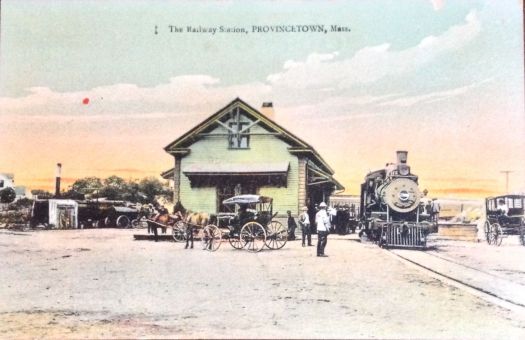
Wouldn’t it be nice to take a train to Provincetown? The last train that provided service to Cape Cod as far as Hyannis, shut down operations in 1986. Yet the railroad was an important mode of transportation to Provincetown businesses, residents and tourists 100 years ago. It was by train that the fresh fish caught by Provincetown fisherman packed in ice was delivered directly to New York City and it was by train that summer tourists and weekend visitors from Boston and New Bedford could conveniently get to Cape Cod vacation resorts and beaches.
As recently as 1960, the freight train was still running all the way down to the end of Cape Cod. When you visit Provincetown and go for walks along the trails, you can walk along the old railroad track bed. The railroad ties left behind when the tracks were removed and have been put to other practical uses by local folk in gardens and landscaping projects, but if you close your eyes you can imagine the sounds of the train chugging through the woods.
The railroad station shown in the 1920 vintage postcard above, was located on Bradford Street in the center of town between Alden and Standish Streets. It opened in 1873 and shut down in 1938. Initially operating as part of the Old Colony Railroad, the New Haven Railroad served the community from 1893 to 1960.
These days, you can get to Provincetown by airplane, car, bus, and boat. Sarah Carreiro (a character in Remaining in Provincetown) takes the small plane from Boston to come back to Provincetown for her husband’s funeral. Looking down from a small plane is a great way to see the unique geography of the Outer Cape, but that’s another story.