Right beside the town hall in Provincetown, on the tip of Cape Cod, was a favorite outdoor sidewalk cafe called Cafe Poyant. Next to the cafe was a bakery with French pastries and donuts. Who remembers the place? It was a great place to “people watch”. The red and white awnings were classic. The large white building in back, once a church as shown on some of the earlier postcards on this website, was the Art Cinema movie theater. They showed wonderful foreign films. The bakery and cafe were owned by Gene Poyant, who in his later years volunteered as the Provincetown Town Crier. Today there is no outdoor sidewalk cafe at this location. As the town has continued to grow and expand. stores and restaurants change, although some favorites remain. What did it feel like to live in Provincetown year-round 25 years ago? If you’ve read Remaining in Provincetown by S.N. Cook, you might have gained a different perspective. If you haven’t read the book yet, read what everyone’s saying about it. Now available at Amazon.com and Barnes & Noble and other online sites in trade paperback and on kindle. Signed copies are at the Provincetown Book Shop while they last. Like us on Facebook. Keep the conversation going.
Tag Archives: old postcards
The Provincetown approach to wooing shoppers
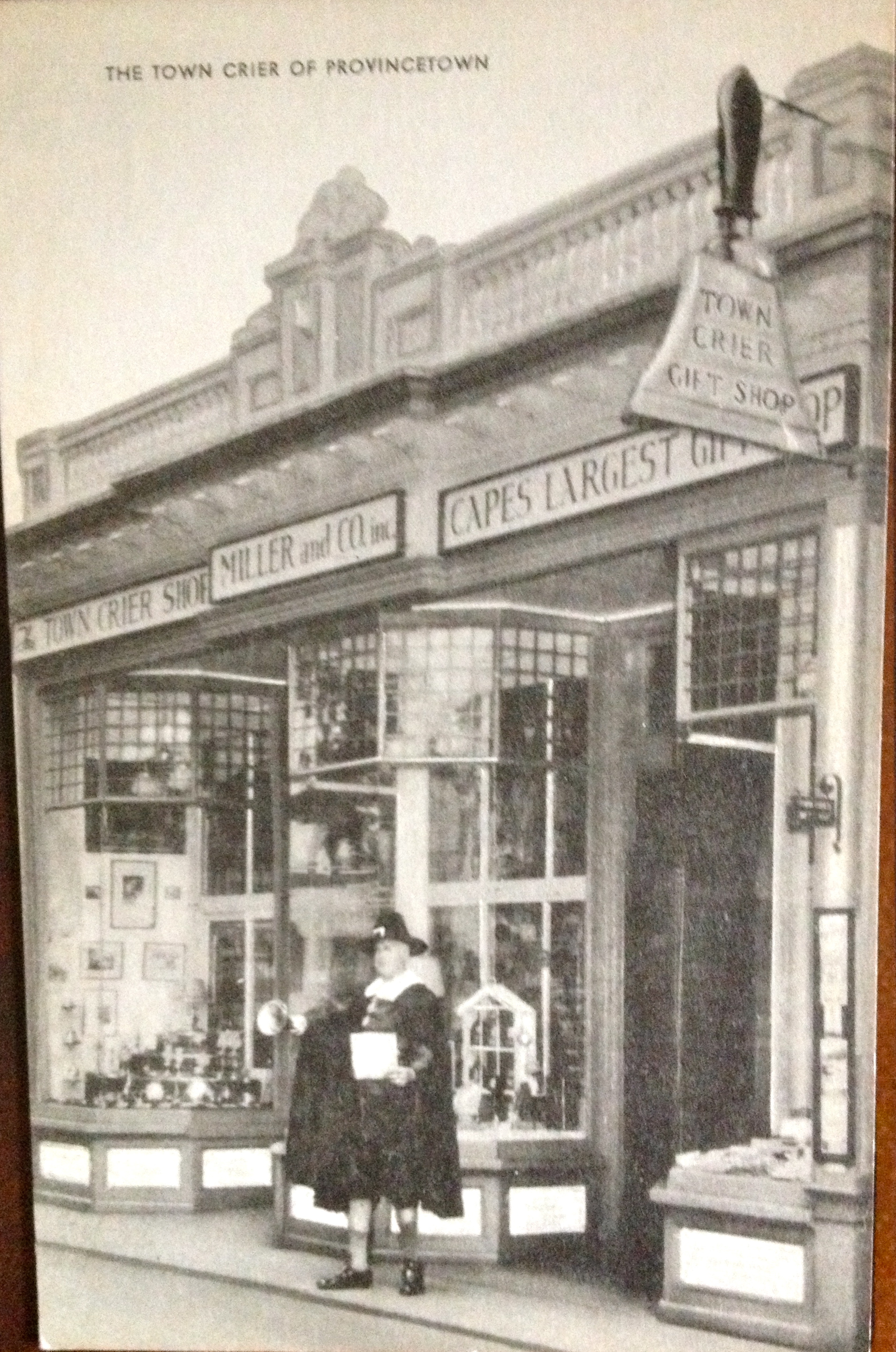
Provincetown, Massachusetts has always been a mecca for shopping. It’s one of the busiest towns on the Outer Cape. This postcard shows 265 Commercial Street, when it was the Town Crier Gift Shop. Prior to that time, this location was the home of the Advocate Gift and Souvenir Shop according to John Wright Hardy the author of Provincetown Vol. I. The gentleman in the pilgrim outfit standing outside the shop, which boasts itself as being the largest gift shop on Cape Cod, was not the official Town Crier for the town of Provincetown but was hired by the store to attract business. His name was Charles Walton. To learn more about Town Criers in Provincetown read some of our previous postings. To be entertained by a Provincetown mystery story read Remaining in Provincetown , available at bookstores and online in trade paperback and as an ebook. Like us on Facebook and keep the conversation going.
Shipwreck on Provincetown sandbars averted
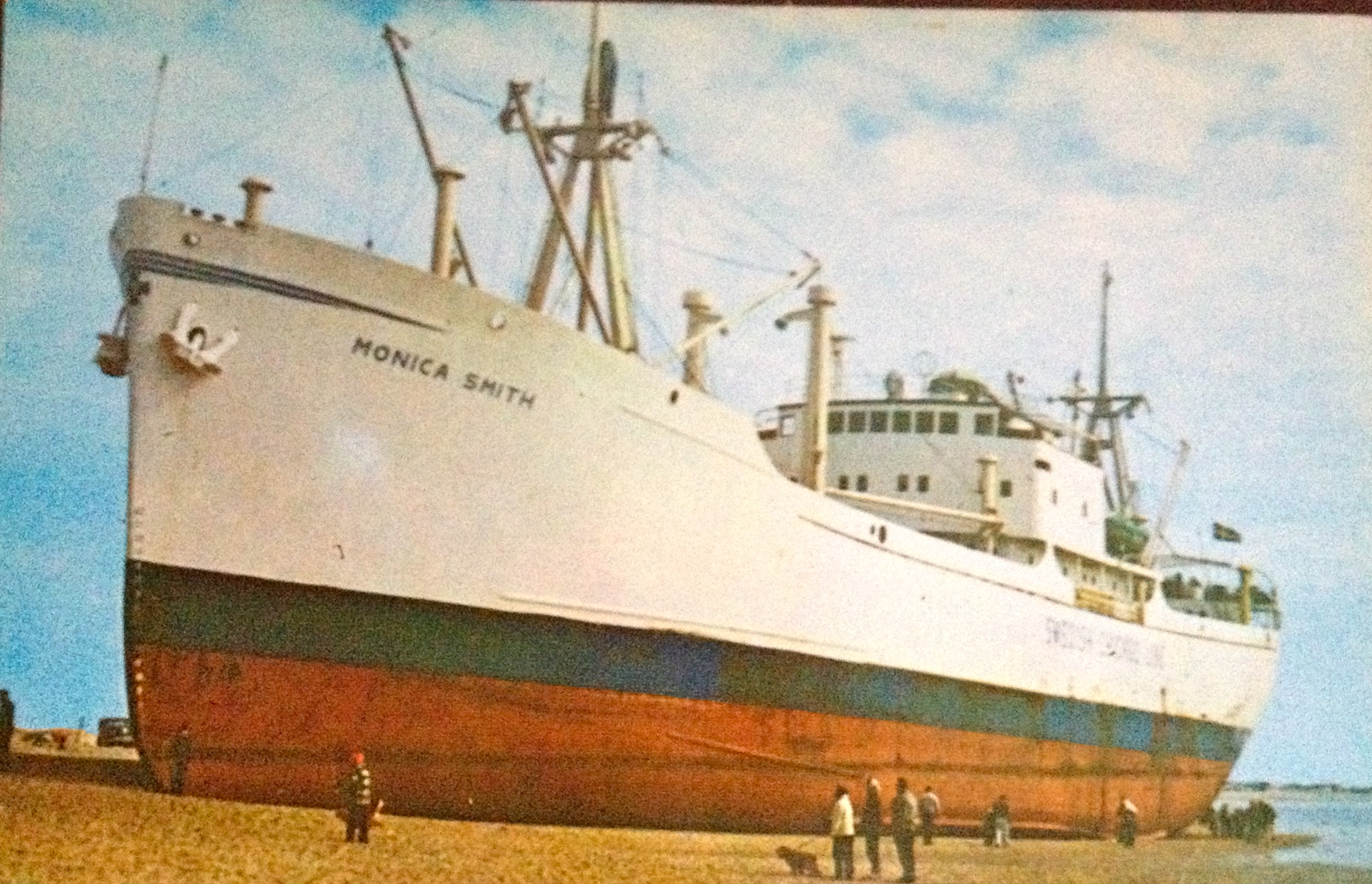
The sandbars off the tip of Cape Cod , even with the Provincetown lighthouses at Race Point, Woods Hole, and Long Point to alert passing ships can be treacherous. Fortunately in the case of the Swedish freighter, Monica Smith, enroute from New Bedford to Nova Scotia, no damage was done. This photograph was taken on February 23, 1960. A storm caused the vessel to be beached at Provincetown, Massachusetts, where the boat remained until tugboats could be assembled and then during high tide, with the help of her anchors, she safely floated out to sea and started up her engines.
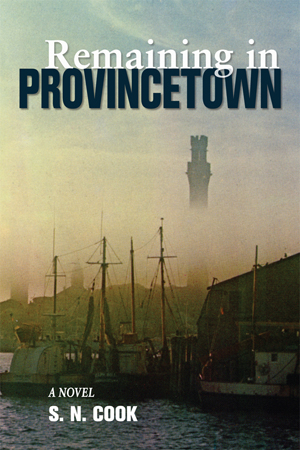
When you live by the sea, you learn to deal with unexpected weather and unexpected events like a murder. What happens in a small town like Provincetown, economically dependent on tourism, when a crime takes place? Who had a motive to kill one of the town’s leading citizens? The ending may surprise you. Get your copy of the new novel Remaining in Provincetown by S.N. Cook in time for summer beach reading. Now in bookstores and online, in trade paperback and as an ebook. Like us on Facebook and keep the conversation going.
Provincetown Cape Cod your heart’s desire
Cape Cod is often referred to as “God’s Country” as it is in the poem by John Chipman printed on the above antique postcard. The top illustration shows the steamer Dorthy Bradford (the Boston Boat ) heading from Boston to Provincetown, the best town from which to start your Cape Cod visit. Today you can visit via the Fast Ferry. Chipman writes of hearing the waves pounding on the short and says “no place in the world shines the sun so bright or the moon so full on a summer’s night.”
“”They make you as welcome as flowers in Spring A hand clasp that thrills way down to the toes In the greeting one gets whereever he goes.”
That sense of intimacy is one of the characteristics of a small town. It’s one reason why so many people gravitate towards places like Provincetown. Want to experience more of what it’s like to live in Provincetown, who maybe what it could have been like for some residents in the 1990’s. Buy a copy of the fabulous new novel, Remaining in Provincetown by S.N. Cook available at bookstores and online in trade paperback and ebook. Like us at Facebook and keep the conversation going.
Provincetown inns and guest houses offer quality lodging
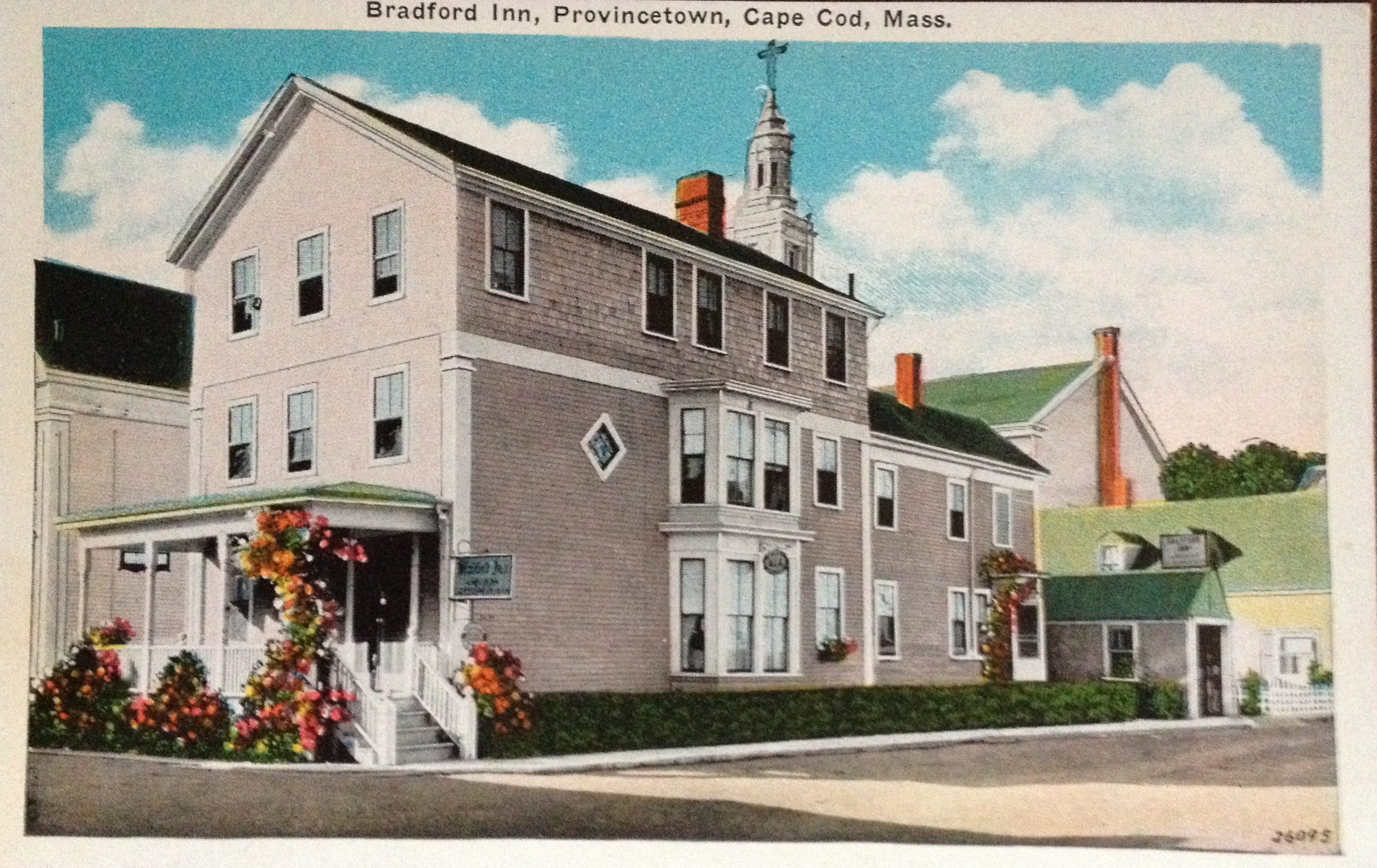
Inns or what have long been referred to as “Bed n” Breakfasts” and “Guest Houses” enable Cape Cod visitors when staying in Provincetown to fully grasp the unique flavor of the town. As shown in the above postcard circa 1900, gracious well maintained Inns have long been a Provincetown tradition. We have dozens of wonderful such places to stay in Provincetown, although you are cautioned to make your reservations early because the best ones fill up fast. One of our favorites is the Revere Guest House which has been featured on the HGTV TV show “If Walls Could Talk”, The HGTV episode provides some insight into the history of the building, revealed by some unusual documents the owners found during renovations, not unusual in a town filled with history. Each room at the guest house has a different name to characterize its slightly different amenities. Decorating rooms to have a unique personality is something that one of the characters, Bruno Marchessi, in the mystery novel Remaining in Provincetown is very proud of accomplishing in his own guest house “The Willows”. Set in Provincetown in early spring, before the start of the busy tourist season, this is a book that will get you in the mood for your visit. Curious to learn more? Visit our page on Facebook and become a fan. We’ll keep you posted with colorful snippets of Provincetown history. Buy a copy of the book, Remaining in Provincetown by S.N. Cook, available online and at bookstores. Purchase your copy now and become transported to another time and place.
Boston boat to Provincetown a vacation experience
The above postcard was mailed in 1912, over 100 years ago, and shows the steamship the Dorothy May Bradford, pulling up to the dock in Provincetown harbor on the tip of Cape Cod. At the begiinning of the 20th century, taking what was referred to as the “Boston Boat” was the most efficient way to get from Boston to Provincetown and from Provincetown to Boston during the summer months. Back in those days the journey took a good half of the day, but today the Provincetown Fast Ferry makes the trip back and forth two and three times a day in 90 minutes. While the Dorothy Bradford was named after one of the first Pilgrim travelers who traveled across the ocean on the Mayflower and then drowned in Provincetown Harbor after she slipped and fell off the boat, the newest Provincetown Fast Ferry Salacia, is named after the Neptune’s wife and goddess of the sea. Salacia’s name, derived from the Latin word for salt, was thought to personify the calm and expansiveness of the sea. A beautiful sea nymph who bore three sons with Neptune, including Triton, she is usually personified in sculptures as having a crown of seaweed and driving alongside Neptune in a shell chariot drawn by dolphins. Certainly the sleek and fast Salacia looks quite different in contour and shape from the more stalwart Dorothy Bradford. But different time periods in history call for different experiences. If you like postcards, you may want to enter the Boston Harbor Cruise “Design Your Own Postcard Contest”
If reading a book during your vacation is more your idea of fun while relaxing on the beach, pick up a copy of Remaining in Provincetown, the new murder mystery everyone’s talking about. Now available at bookstores and online in trade paperback and ebook. Buy your copy today at Amazon .com or purchase a signed copy at the Provincetown bookshop while supplies last. Like us on Facebook and keep the conversation going.
Provincetown’s Town Hall vintage postcard pre Meat Rack
The scene in the above antique postcard shows the center of Provincetown, Cape Cod, and its Town Hall. Notice there are no benches in front of Town Hall. They were added mid 20th century. Those benches have become known as the “Meat Rack” for two reasons. During the daytime it’s a place to watch everyone walking by and check out who is in town. At night, particularly after the bars close, it’ a meet-up spot for singles, particularly gay men looking to run into an old friend or meet someone new. In the recently released mystery novel Remaining in Provincetown, with all -the clandestine meetings between the Publisher/Editor of the weekly newspaper and the Town Manager–there’s a fair amount of action that takes place near and around Town Hall.
Also notable in this photograph is the view of the Congregational Church, as it originally appeared before it became a movie theater (the old Art Cinema) and then shops, a sidewalk cafe, bakery, and restaurant — during the 20th century. Want to read a book that “captures the town to a T” ? Pick up a copy of Remaining in Provincetown by S.N. Cook available at bookstores including The Provincetown Bookshop and online in trade paperback and on kindle. Like us on Facebook and keep the conversation going.
Provincetown art students painting en plein air
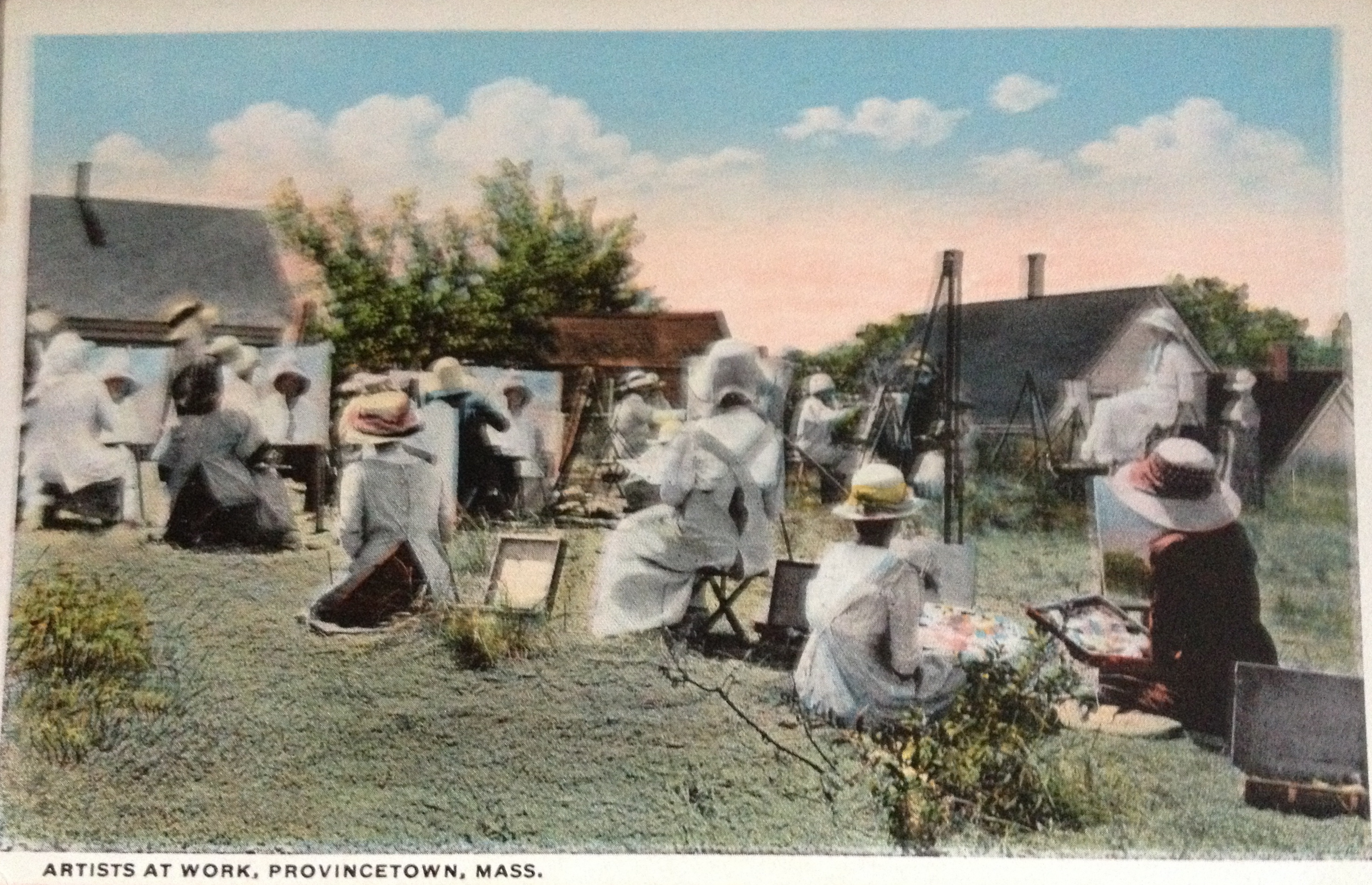
Painting in the open air, (en plein air in French), has been a favorite practice of artists in Provincetown, Massachusetts since Charles Hawthorne (1872- 1930) founded the Cape Cod School of Art in 1899. Given Provincetown’s waterfront setting, one might assume that Hawthorne’s students always set up their box easels on the beach. The sun’s reflection on the water, and the light and shadows on the sand, were perfect starting points to practice the concepts of Impressionism, which put an important emphasis on capturing on canvas, the artist’s impression of how light changes throughout the day. . Not true, as shown in this antique postcard published by H.A. Dickerman & Son, Taunton, Massachusetts in approximately 1900. The students, primarily female, are painting a portrait of the model positioned in the right, dressed in a while summer frock and hat with a long braid. Student artists often used local citizens as their models.
The availability of paints in tubes made painting en plein air, so much easier when compared to the practice of grinding and mixing pigment powders with linseed oil. Notice in the photograph that the boxes to hold paints and contain a palette, also made transporting equipment for painting outside so much easier. Artists came from all over the world. and still do, to live and work in what was originally a fishing village.
Creating art is important to Annie Tinker, a sculptor who first came to Provincetown as a student at the Fine Arts Work Center. One of the characters in the recently released novel, Remaining in Provincetown by S. N. Cook. She’s married to Beau Costa, the former business partner of Sonny Carreiro who has been murdered. Could Beau be a suspect? Haven’t read the book yet? Signed copies are available at the Provincetown Bookshop downtown on Commercial Street or you can buy a trade paperback or ebook online at a variety of sites including Amazon. Visit our Facebook page , like us and join the conversation.
New Provincetown Book inspired by Town Crier history
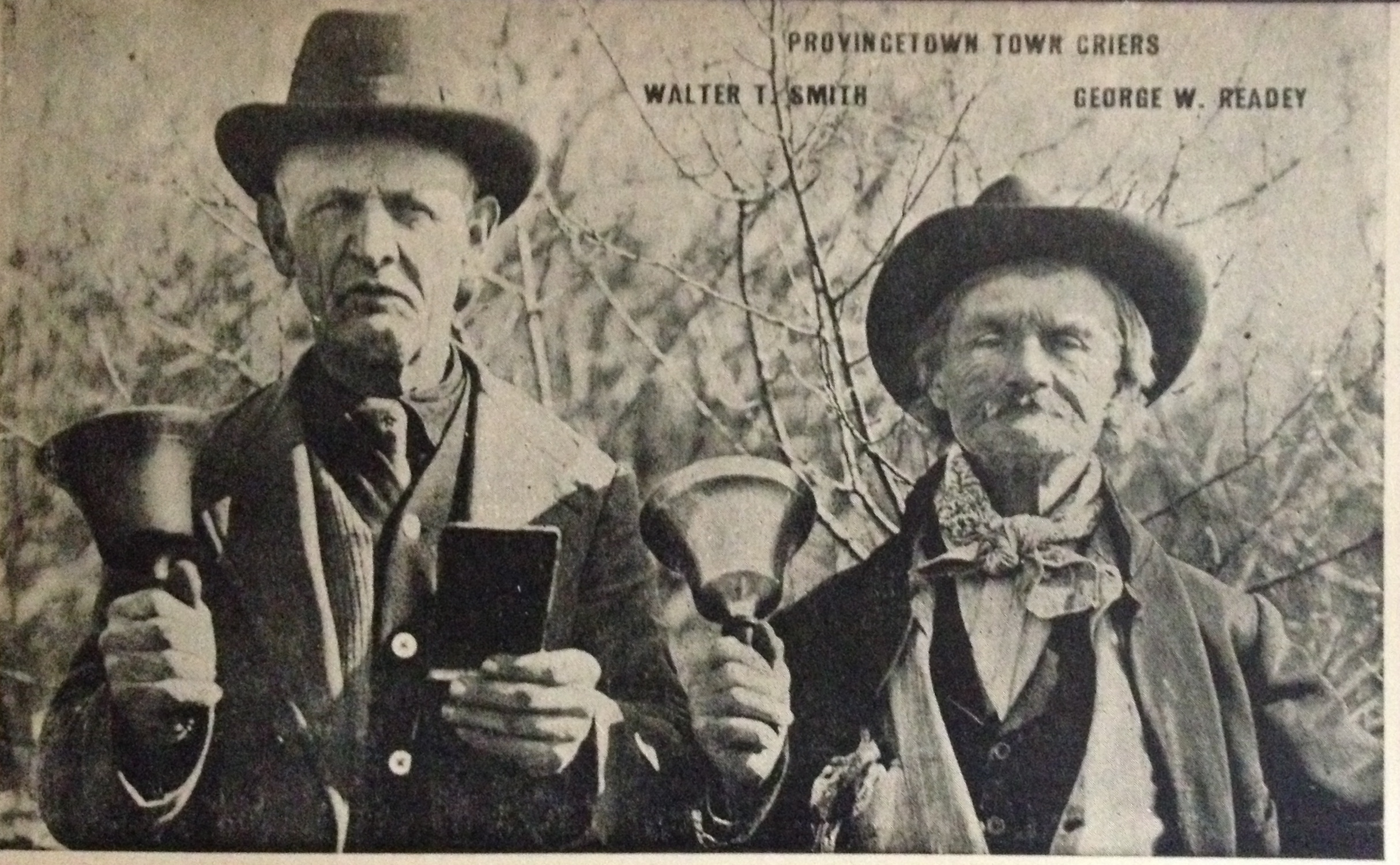
A rare antique postcard shows two of Provincetown’s early 20th century Town Criers together in one photograph: George W. Ready and Walter T. Smith. George Washington Ready wore regular street clothes while practicing his profession, clothes that gradually became more old and dilapidated as he advanced in age. He was known to have a remarkable vocabulary, but in his official capacity as Town Crier, restricted his language to what he was contracted to recite.
Walter T. Smith, known as “Hoppy” Smith served as the Provincetown Town Crier for 27 years and at age 78 resigned his post due to lameness in 1927. (Perhaps he walked with a hopping gait and thereby the nickname?) The July 16, 1927 Farmers Advocate newspaper published in their weekly issue that “he is believed to be the last Town Crier in the country” But of course her was not the last Town Crier, because Amos Kubik went on to succeed him, as documented in a 1938 Provincetown Advocate article about Kubik making a trip from Provincetown, Massachusetts to Washington D.C. to perform at the National Folk Festival on the Mall.
In the 1980s Gene Poyant went on to revive the Town Crier Tradition on Cape Cod and now the calling of being a Town Crier has been revived in many cities globally. There is a World Invitational Town Crier Championship from August lst to August 5, 2013 in Kingston Ontario.
And while Provincetown doesn’t currently have a Town Crier it might have been an inspiration for the name of a local magazine because freedom of the press and breaking up the monopoly of one small town newspaper is a big issue with the characters in the new Provincetown book Remaining in Provincetown by S.N. Cook. Antique postcards are also important in the story. Native son Sonny Carreiro is an obsessive collector. Haven’t read the book yet? Signed copies are for sale at the Provincetown Bookshop and copies are also available online in trade paperback and on kindle. Find out what people are talking about on our Facebook page.
Provincetown, Cape Cod postcard puts the emphasis on quaint
Greeting from Quaint Cape Cod, says the vintage 1960s postcard. So exactly what does quaint mean? Well it depends on which dictionary you consult. In the “Free online dictionary” the primary definition of the word quaint is:“Charmingly odd, especially in an old-fashioned way. “Miriam Webster’s primary definition is: obsolete and their secondary definition is: “marked by skillful design or marked by beauty and elegance.” Other meanings of the word quaint emphasize the uniqueness of the person, item, or place. Call something quaint and not only is it a little different, but possibly it takes you out of your comfort zone.
How do you describe a place like Cape Cod, rich in history, beautiful, unique, and yes different—particularly Provincetown, the town on Cape Cod’s very tip ? And if you write a book about the town, how do you capture all the different nuances and various types of people who call Provincetown their home. Remaining in Provincetown, the new mystery novel released in April, doesn’t always follow the rules when it comes to traditional mystery stories. There are lots of characters and lots going on, as there is with a town as “quaint” as Provincetown. Want to find out more? Pick up a copy of Remaining in Provincetown by S.N. Cook at your local bookstore (now in stock at Provincetown Bookshop) or online at various sites at Amazon.com in trade paperback and as an ebook. Like us on Facebook. Keep the conversation going.