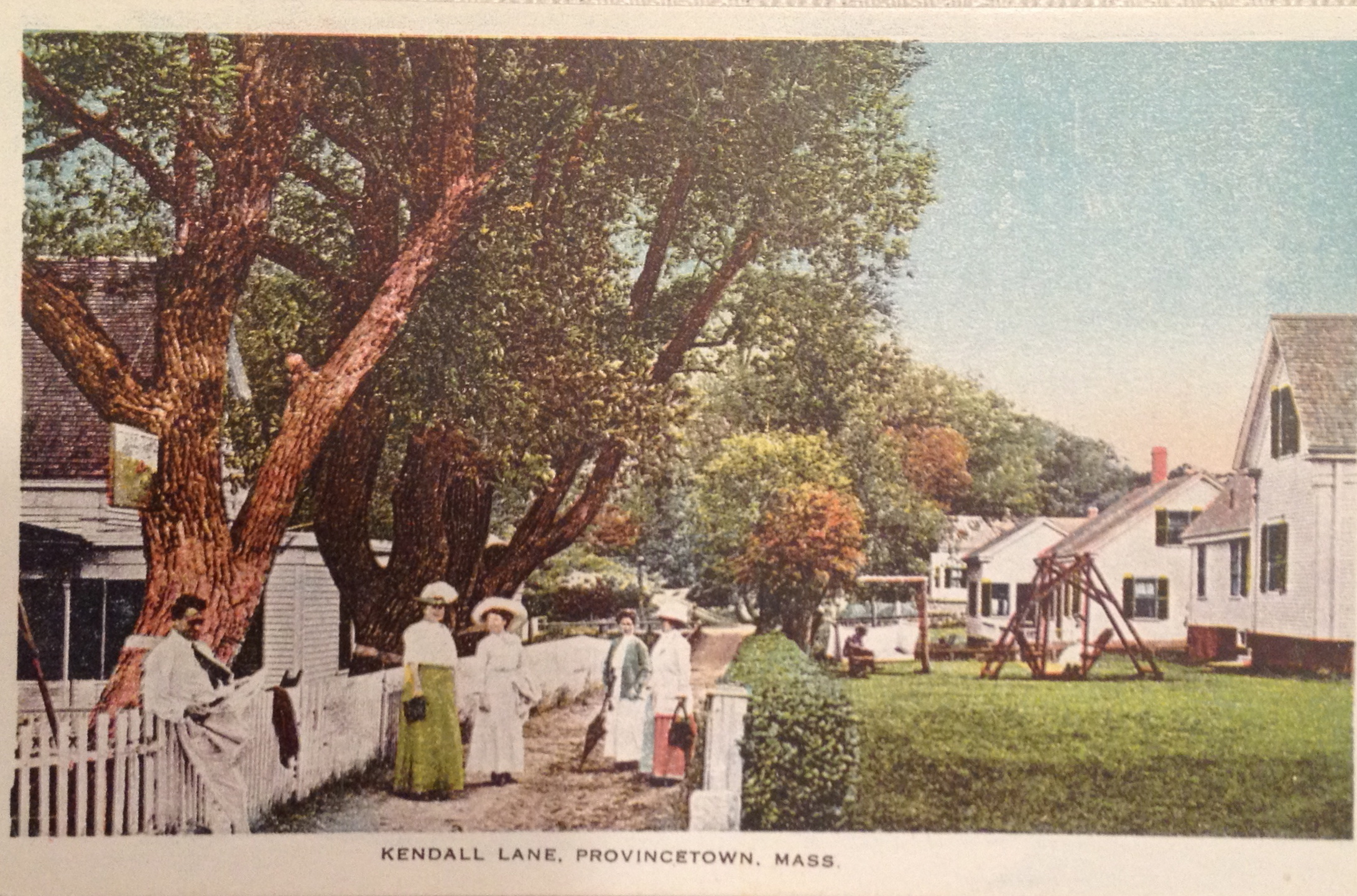
What did Provincetown, that lively town on the tip of Cape Cod, look like before there were big motels? Stand on the corner of Commercial Street and Kendall Lane on the town’s East End and imagine. Once upon a time before there was a big parking lot and a pool for the Surf Side Arms Motor Inn on this left corner, there were mature trees and a white picket fence. Kendall Lane was an actual dirt lane, not a paved street. It was a setting that invited strollers who chatted and admired the greenery on their way towards the town landing near by.
How times have changed. But it’s fun to look at the above antique postcard and remember. Want to remember the 1990s? Pick up a copy of the murder mystery Remaining in Provincetown by S.N. Cook, this year’s favorite new book set in Provincetown. Buy a copy at the Provincetown Bookshop or online. It’s available as a trade paperback and an ebook. Like us on Facebook and keep the conversation going!
Tag Archives: Cape Cod
1951 in Provincetown Cape Cod
This colorful vintage postcard was mailed to Troy, New York the summer of 1951 and says, “This is really wonderful here. Just finished a shore dinner.”. Look closely at this picture and you will see the sign for “The Lobster Pot” restaurant in the very same spot it is today 62 years later, although the sign does look different. Wonder if that is where “Mary, Jack, and Jimmy” enjoyed their shore dinner.
Love the classic cars! If you enjoy remembering Provincetown the way it used to be a few decades ago, check out Remaining in Provincetown by S.N.Cook, available at your favorite local bookstores including the Provincetown Bookshop on Commercial Street (autographed) and also online as a trade paperback and ebook. Like us on Facebook and keep the conversation going.
Downtown Provincetown Freeman Street History
During the busy summer months its easy to miss all the lovely side streets in Provincetown which join the main two thoroughfares–Bradford Street and Commercial Street. The above postcard, a color lithographic print from the late 19th century is entitled “Glimpse of Freeman Street”. What you don’t see is the building , donated by Nathan Freeman in 1873, which once served as the Provincetown Public Library. The Freeman Street library opened to the public in June of 1874. In the mystery novel Remaining in Provincetown by S.N. Cook, set in approximately 1990, the library is at that location on the corner of Freeman and Commercial Streets. Today the library resides in what was once the Center Methodist Episcopal Church built in 1860. During the time period in which Remaining in Provincetown takes place, the building (once the Chrysler Art Museum) is still the Provincetown Heritage Museum. In 2005 it became the Provincetown Public LIbrary. Want to read a story that takes place in Provincetown a few decades ago? Remaining in Provincetown is available online and at your favorite bookstores. Like us on Facebook and keep the conversation going.
Railroad Wharf Provincetown Cape Cod Sailing Vessels
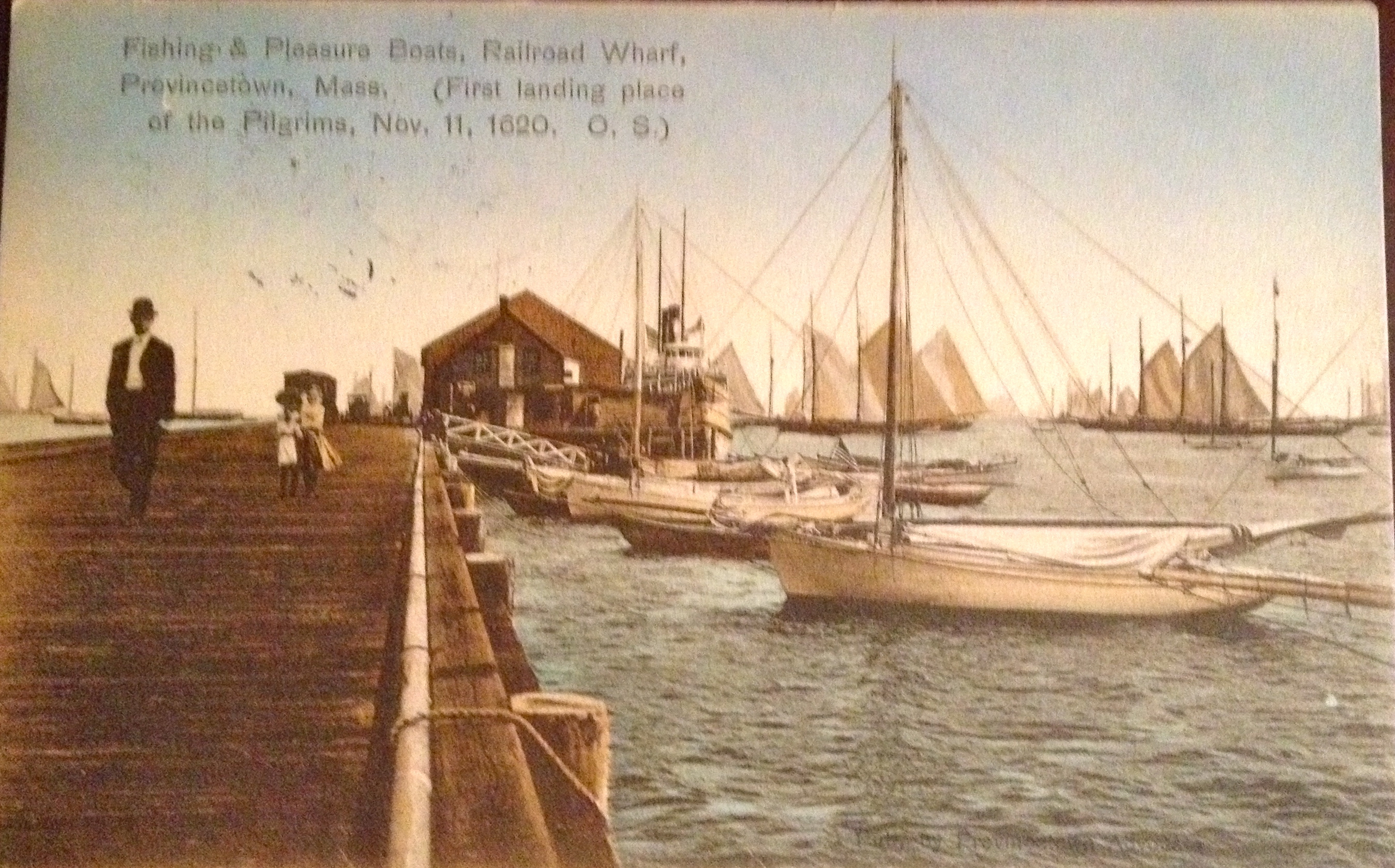
This postcard, a hand colored photograph, was mailed from Provincetown Massachusetts to Bethehem New Hampshire in 1908. Titled “Fishing & Pleasure Boats, Railroad Wharf, Provincetown, Mass” it was published by The Robinson Brothers in Boston and was printed in Germany and distributed by the Metropolitan News Company.
It is a lovely picture which shows the gracefulness of the sailboats used for recreation and the handsome schooners used for fishing. Before there was a Macmillan Wharf, the main downtown wharf in Provincetown was known as Railroad Wharf because the railroad tracks ran all the way down to the end in order to easily load fish off the fishing boats for shipping (with some ice of course) straight to major cities that included New York. It was back in the days when men wore bowler derby hats and a child might carry a parasol. Horses and carts were still being used, along with the first automobiles. That was long ago and times have changed. The town on the tip of Cape Cod continues to evolve. What was it like a few decades ago? To get an impression, read the new mystery novel Remaining in Provincetown by S.N. Cook. Available online where books are sold and locally in Provincetown at the Provincetown bookshop (autographed). Like us on facebook and keep the conversation growing.
Truro Cape Cod Pamet River
If you live in Provincetown, you spend time in Truro–the adjacent township which is more rural in its setting. Or maybe you work in Provincetown and live in Truro. One of the beautiful spots in the town is the Pamet River. Over four miles in length, the river is named for the Paomet Indian tribe who lived on Cape Cod. It is probably their corn the pilgrims stole from Corn Hill after they initially landed in Provincetown Harbor and then went further down the Bay in pursuit of food.
WIth the changes that winter storms have wrought on the coastlines during the past few years, its interesting to see this old postcard that was mailed in 1927 from Truro to Carver Road. The writer was evidently staying in Truro but talks about going into Provincetown to enjoy parades and celebrations. So even back in the 1920s, Provincetown was the place for parties. Want to learn more about Provincetown read Remaining in Provincetown by S.N. Cook, available online and in local bookstores. Like us on Facebook and keep the conversation going. Pick up a copy of this week’s Provincetown Magazine and read a brief excerpt from the book.
Champion Provincetown Clam Digger
Quahogs and steamers were once in plentiful supply in Provincetown harbor. The above antique postcard is a 19th century color lithographic print published in Germany by F. H. Dearborn, Provincetown Massachussets. The card shows a champion clam digger, “Carl”, wheeling his haul down Commercial Street standing in front of what is now Marine Specialties.
Clams were often used for fish bait. Nowadays Cape Cod clams are enjoyed fried, stuffed, steamed, and in chowders. Because the clam population has become depleted due to overfishing, clam digging is closely monitored and restricted according to season. But during the Great Depression, shellfish was an important source of protein for Cape Codders.
Everyone loves a creamy hot bowl of Clam Chowder on a cold damp day. A number of Provincetown restaurants serve delicious homemade chowder and one restaurant “Sally’s Chowder Bowl,”–a fictional location, is a favorite dining spot of several of the characters in Remaining in Provincetown, the mystery novel by S.N. Cook. Who likes to eat there and why? Read the book everyone’s talking about available online and at local bookstores. Like us on Facebook and keep the conversation going.
Provincetown Cape Cod Seining Fish
This antique Provincetown postcard is entitled “Seining Fish” and was published by the Provincetown Advocate in the late 19th century. The American Indians used weirs, stationary nets to capture fish and fishing weirs were still a common sight in parts of Cape Cod Bay in the 20th century. But another fishing technique, popular in the 19th century as depicted in this antique Provincetown postcard, was seine fishing. Seine fishing uses nets that are hung vertically in the water, set in place to catch a school of fish and then removed. The bottom edge of the net is held down by weights while the top of the net edge is held aloft by floats. Purse seine fishing uses rings on the edges of the nets to gather the net together like a purse. That’s where it gets its name—purse seine.
Names can be very descriptive. What is the significance of the name of the novel, Remaining in Provincetown by S.N. Cook? Who is remaining? Is it the murder victim or is it the characters who have chosen the town as their home and have chosen to stay? Want to learn more? Read the murder mystery available at your local bookstore or online as a trade paperback or ebook. Like us on Facebook
and keep the conversation going.
U.S. Lifesaving Service at Race Point, Provincetown
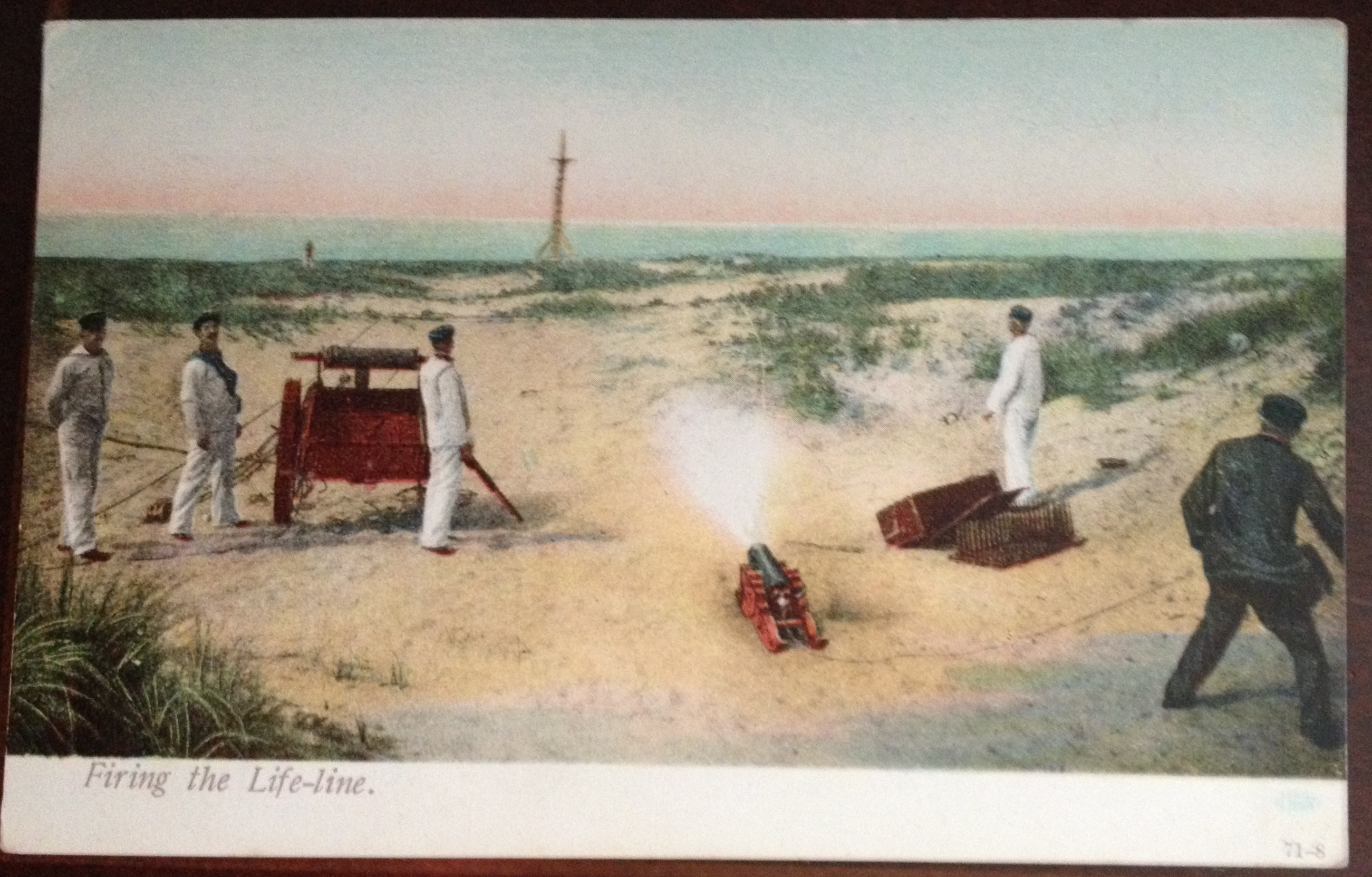
The United States Lifesaving Service was founded in 1871 after an alarming number of fatalities occurred along the Atlantic coast during the winters of 1870 and 1871.
The stations were manned by expert surf men and boat handlers who patrolled the coast at night and during foggy and stormy days. The buildings where equipment was stored were painted red so they could be seen from the sea and a sixty foot flagstaff signaled passing ships by International code.
Nine lifesaving stations were built on Cape Cod in 1872. Captain Samuel O. Fisher was one of the Race Point station’s keepers and he had a horse that would help the crew by dragging the heavy boats and equipment across the sand. Postcards that show the work of the early Cape Cod Lifesaving Service are highly desirable. It was a these types of antique postcards that Sonny Carreiro was looking at before he drives back to Provincetown and is inexplicably murdered. Want to know more about the mystery? Read the new novel, Remaining in Provincetown by S.N. Cook available at bookstores, including signed copies at the Provincetown Bookshop and online in trade paperback and as an ebook.Like us on Facebook and keep the conversation going.
Provincetown 19th Century Fishing Dock
Walk down the Provincetown wharf and docked at the very end are a few fishing boats with steel hulls and large dragging nets, called draggers.. Fishing has always been a hard way to make a living, but with quotas on how many fish of a certain specie can be caught, it”s even more challenging. The beautiful color lithograph postcard above shows what it was like on the docks in Provincetown in the 19th century when fishing was in its heyday, Times and circumstances change and while fishing is no longer lucrative there are opportunities for whale watching and fishing excursions for visitors. On a September weekend, the town is busy. Want to learn more about what it is like to live in Provincetown. Return to the 1990s in Remaining in Provincetown by S.N. Cook now once again available at the Provincetown Bookshop and online at Amazon.com in Trade paperback or as an ebook. Like us on Facebook and keep the conversation going,
Finback Whale on Provincetown Beach
The above postcard sent from Provincetown, Massachusetts to Woodbridge, Connecticut in August 1968, when it cost five cents to mail a postcard, doesn’t say when the Finback whale was stranded. Looking at the buildings, the location is the East End of town, not too far from Dyer and Washington Streets. It’s when you see all the people gathered around that you start to comprehend the immense size of the whale. It’s very sad. One of the largest baleen whales,
adult Finback whales can reach an average size of 60 feet and weigh close to 50 tons. Scientists estimate the Finback whale and other large baleen whales have life spans of about 60 to 70 years. Walking along the beach, one never knows what you will find. A clue to a mystery, perhaps or some insight into why whales beach themselves. If the newspaper in Remaining in Provincetown, The Provincetown Observer were real, it would have been a front page story. The publisher and editor Roze Silva, however, finds other things that will make headlines. What’s everyone talking about? Check it out by reading the book, available at local bookshops and online in trade paperback and as an ebook. Like us on Facebook and join the conversation.