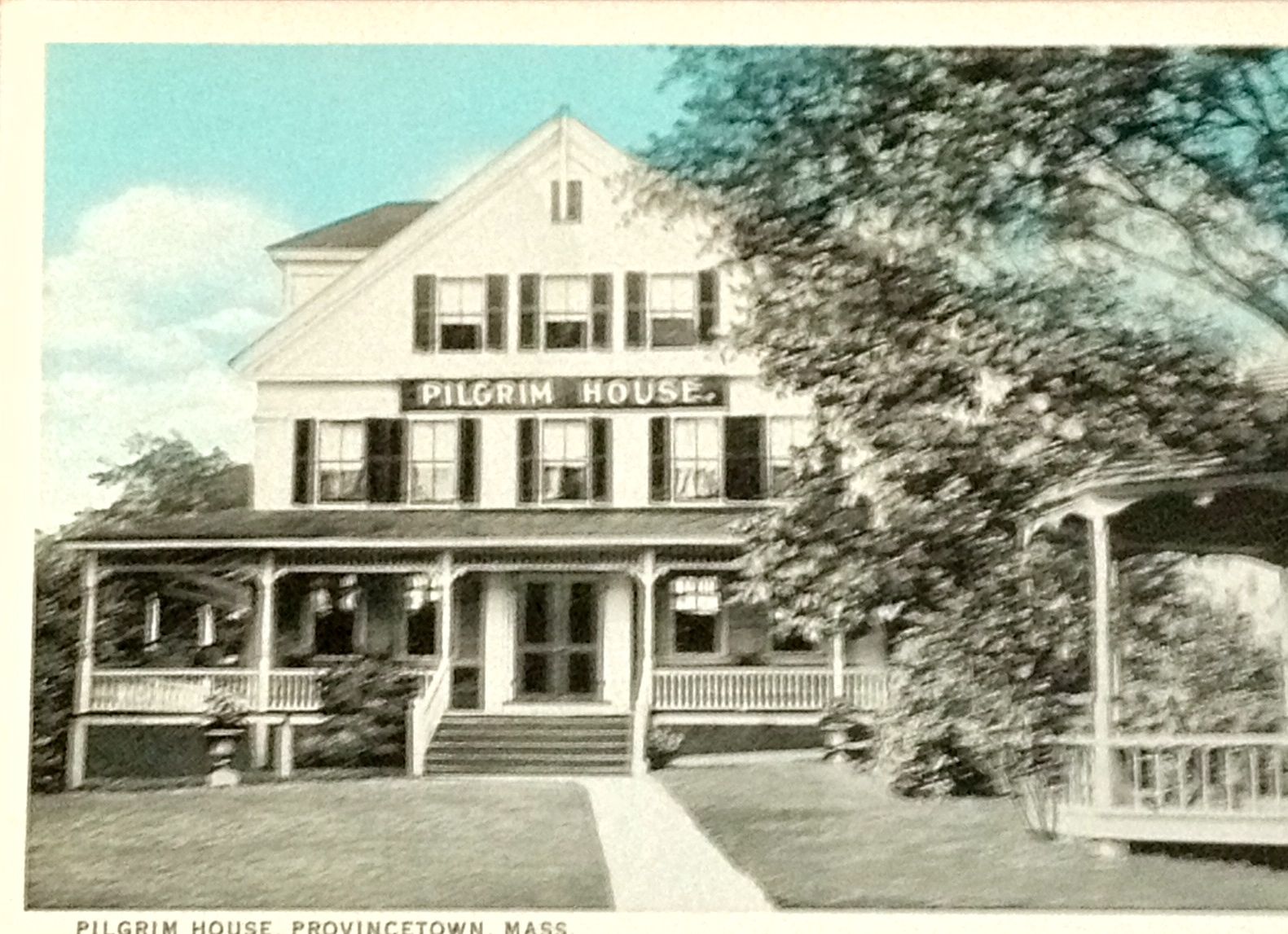
The night life in Provincetown includes many different types of entertainment including drag shows like the famous performances by Lynne Carter at the Pilgrim house during the 1960s. After all, people are not always who they appear to be and looks can be deceiving. A favorite place to gather was the Madeira Club. It didn’t matter what your sexual preference– gay, straight, or bi— everyone appreciated Lynne’s performances as Bette Davis. In the mid 1970s Carter purchased the Club. Too bad that nothing can last forever. In 1990 the Pilgrim House was destroyed by arson. Hmm arson… A mysterious fire? Arson does figure into the plot of the soon-to-be released mystery novel Remaining in Provincetown. Keep following this site to find out exactly when the book will be available. We’ll also be giving away a few free copies and if you’d like to suggest sales outlets… let us know. Thank you!
Tag Archives: Cape Cod
Provincetown Sand Dunes for love and recreation
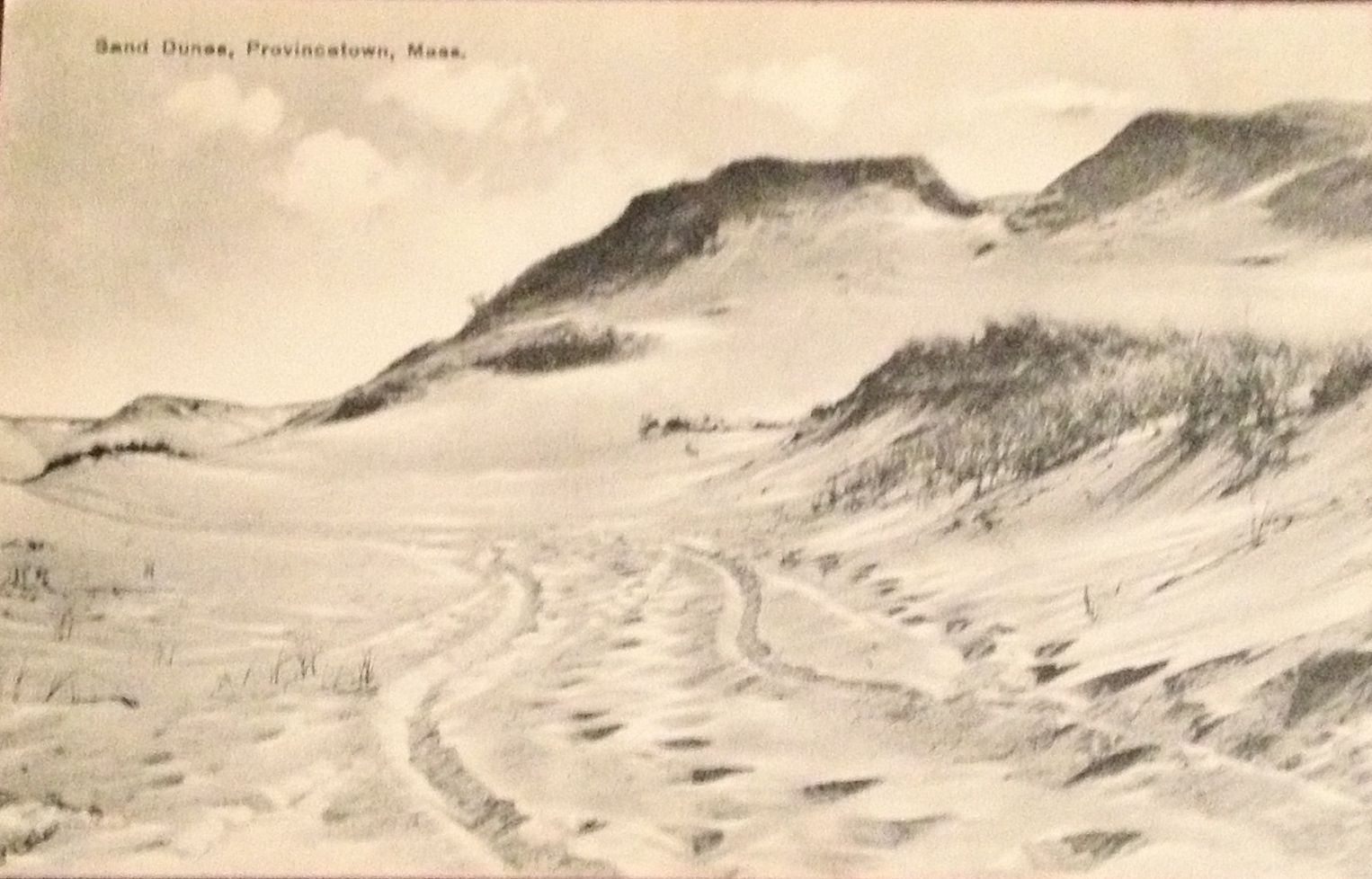
The sand dunes at the tip of Cape Cod, between Bay and Ocean have shifted with the wind, but the dunes have always been a secret place for hikes and love trysts. You can get across the sand on foot, horseback, or four wheel drive vehicle (with a special license) . Their beauty has inspired scores of artists and photographers. Are the Provincetown sand dunes a special meeting place for lovers? Where are the secret places two star crossed lovers might rendez-vous? It’s stories you’ll read about in the soon-to-be-released novel Remaining in Provincetown.
Provincetown souvenirs are collectibles and memories
Provincetown in summer is a bustling place. The narrow streets are crowded with tourists. Even 100 years ago when the fishing industry provided year-round income for families, the tourist trade was important. Souvenir shops that sold postcards, like this one shown above, as well as collectible souvenir spoons, plates, paper weights, and glasses provided seasonal income for local residents. Servicemen in the Coast Guard and Navy would come into town to see the sights that included fine restaurants, bars, and entertainment. The T-shirt shops came later! Town Hall in this antique postcard is partially obscured by the thick foliage of the trees, but it looks very much the same today as it did back then. In 1990 when the novel Remaining in Provincetown takes place, Town Hall was painted white and one of the characters has their office inside. Which one? You’ll have to read the book to find out.
Race Point Beach a part of Provincetown history
Provincetown’s National Seashore, managed by the National Park Service, includes historic Race Point beach and Race Point Light. The Race Point Lighthouse served as an important beacon to ships before the days of radar and radio. Many ships were wrecked on the sand bars off the tip of Cape Cod and a rescue station was located not far from the lighthouse. Today, if you visit Provincetown be certain to spend time at all the gorgeous beaches and visit the restored Lifesaving Museum that was moved to the site from Chatham in 1977. It was called the Harbor Life-Saving Station and it was built in Chatham in 1897. The original Provincetown station did not survive the ravages of time. On Thursday evening you can see rescue re-enactments .
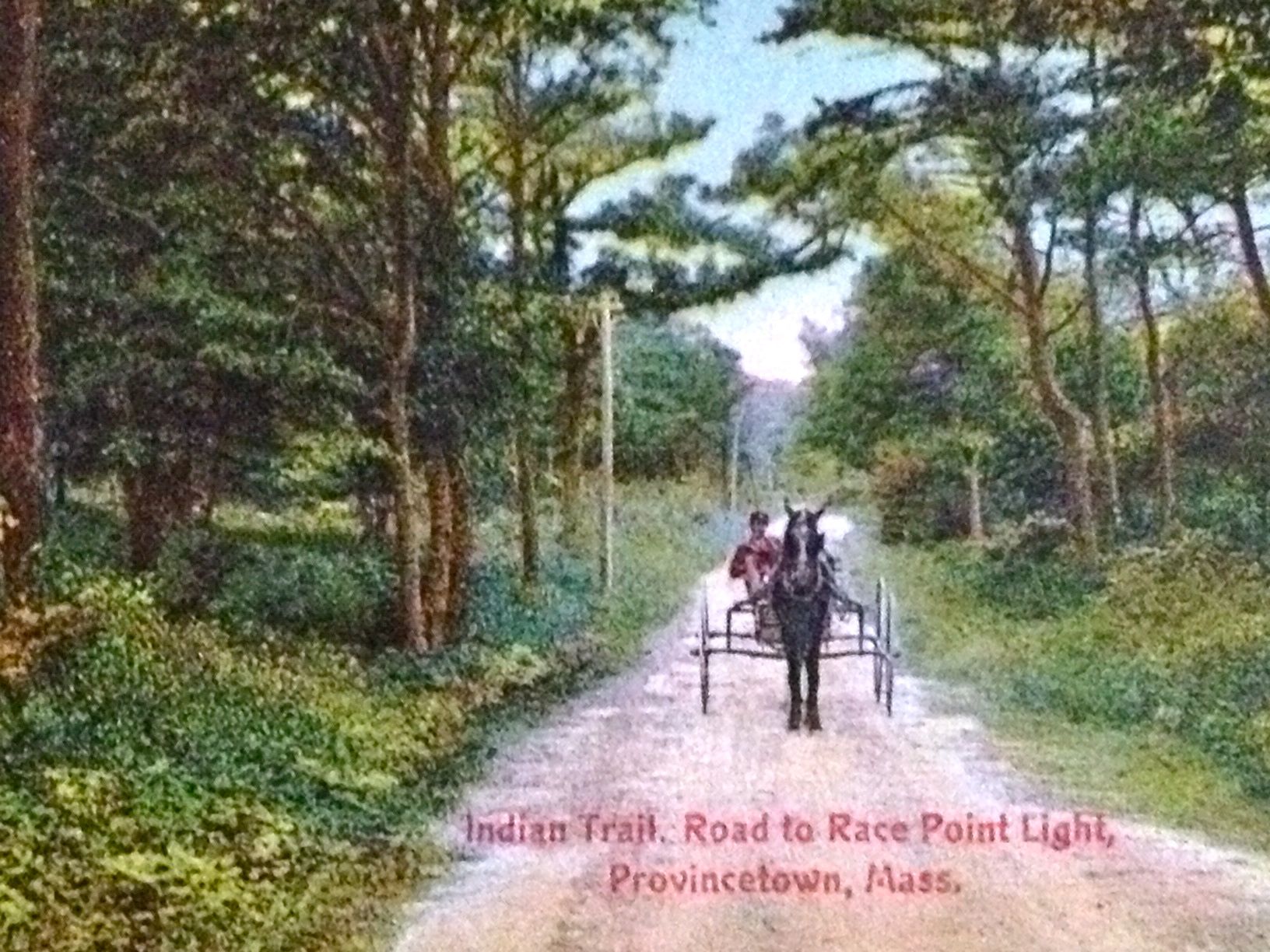
While the roads are no longer dirt roads, there are still patches of woods and overhanging trees as you follow the route from the center of Provincetown across Route 6 and towards Race Point Beach. There are many trails across the sand dunes., some just meant for walking. Printed in Germany and sold during the era when it cost only a penny to mail a postcard for domestic delivery, this beautiful card appears to be made between 1880 and 1900. Antique postcards are important to one of the characters in the soon-to-be-released novel Remaining in Provincetown. You might go so far as to say they were almost an obsession.
Provincetown’s Red Inn a favorite Cape Cod tourist destination
Restaurants in Provincetown come and go, but a few favorites like the Red Inn situated on the waterfront on the far West End of town, have stayed in operation for close to a century. The above vintage postcard shows what the Inn looked like after renovations in 1915 when owner Mary Wilkinson opened her house as “The Red Inn”. Originally the house was built by ship’s captain Freeman Atkins for his wife Emily. The names “Freeman” and “Atkins” are names you’ll see associated with some of the narrow streets in this unique town on the tip of Cape Cod. One road, that figures into the soon-to-be released novel Remaining in Provincetown is called Atkins Mayo Road.
One of the small private dining rooms inside the Red Inn is named after Ada Raynor, wife of Henry Hensche. Hensche was the founder of the Cape School of Art in 1930 after the death of Charles Webster Hawthorne, who founded the Cape Cod School of Art.. Art Schools and artist continued to frequent the Outer Cape. in 2010 former students of Hensche: John Clayton, John Ebersberger, Cedric Egeli, Rob Longley, and Hilda Neily, founded the Cape School of Art in Provincetown, in an effort to pass along Henry Hensche’s teachings.
The Red Inn has always been a gathering place for visiting celebrities and was one of the shot locations in a 1987 Norman Mailer movie, that although a flop at the box office, attracted Isabella Rosselini, Ryan O’Neill and Farrah Fawcett among others.
The ownership has changed through the years, but having dined there recently I can attest to the high quality of what is served. The menu features local seafood, and local produce creatively prepared and well presented. Plus there is that fabulous view to enjoy, looking towards Long Point Lighthouse. It’s the perfect setting for a mystery novel.
Provincetown fishing wharf from bygone era
When fishing was a major industry on Cape Cod, there were fishing weirs, nets set up in the water used to trap fish. The use of weirs for fishing was a Native American technique that was taught to the early colonists in New England. Could the name Consolidated Weir Company name have something to do with the use of weirs? While weirs were a frequent sight in the harbor during the early part of the 20th century, they were abandoned or removed by the late 1960s. This was long before I was born but I do recognize a building in the background that provides a clue to where this long ago wharf in Provincetown was located. The building was on the East End of town, the old ice house which provided the ice for packing the fresh caught fish for storage and transport. Visit Provincetown today and in its place is a stucco and brick building. All that are left of the wharfs on beach side are a few wood pilings.
What still remains in Provincetown from the early fishing era? Or should I ask, who is still Remaining in Provincetown? I love a good mystery.
Provincetown Bathing Beach a Tourist Attraction
It was a time of discretion , when men and women covered themselves for the sake of modesty when bathing at a public beach. Brown’s Bathing Beach in Provincetown, was such a place where there were booths for changing into the appropriate bathing suits. Automobiles and trains enabled tourists to travel to scenic beach side resorts such as Provincetown, located on the tip of Cape Cod. It was a popular destination. With its narrow streets and houses built along the waterside, many guest houses and hotels established thriving businesses. Shops and restaurants geared to the tourist trade soon followed, creating a seasonal economy. Nowadays Provincetown is still a popular summer destination with a seasonal economy. It’s the winter economy that can be challenging for those who live on the Outer Cape year-round, Curious to know what it’s like in early spring before the tourist season? Read the soon-to-be-released novel Remaining in Provincetown.
Giant Halibut caught in Provincetown Massachusetts
It’s been a long time since Halibut have been commercially fished off Cape Cod. This old postcard photo must have been taken in the last decade of the 19th century! Halibut supported important commercial fisheries from the early 1800s to the 1880’s but was severely over fished in the 19th and early 20th centuries. Thus you are unlikely to catch any Halibut off Cape Cod or Provincetown and if you do, there is a bycatch limit of one fish per trip and the fish must be at least 36 inches in length.
Halibut is the largest species of flatfish found in the northwest Atlantic Ocean. Maybe one day, if the population is allowed to increase enough to create a thriving population, sports fisherman will once again be holding up a large Halibut they’ve caught for a photo opportunity.
Currently if you go out on a fishing charter boat from Provincetown harbor, depending on the season you will be fishing for Striped bass, Blue fish, Fluke, Codfish, or Blue fin tuna.
The love of fishing is pervasive and remains in Provincetown.
Welcome to Provincetown
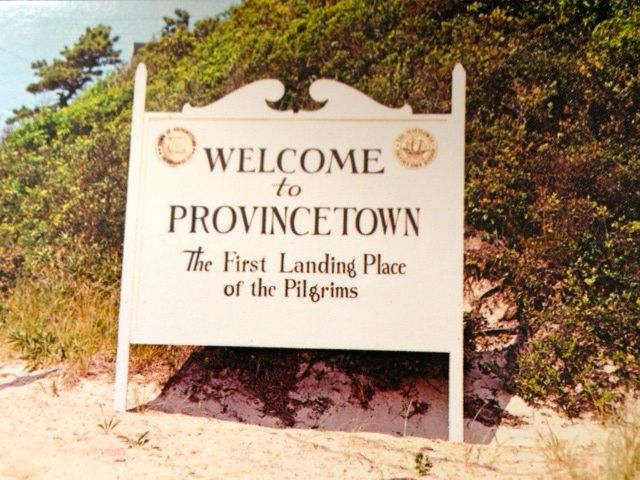
The welcome sign when you first arrive in Provincetown was replaced several decades ago, and while the message still says “welcome” and recognizes the importance of the fishing industry, the old sign let visitors know that counter to what many children are taught in school, Provincetown not Plymouth was the first landing place of the Pilgrims. VIsiit Provincetown and at the Pilgrim Memorial Monument and Museum you can learn more about the Mayflower’s
visit to Cape Cod. There are many things about Provincetown the casual visit may not be aware of, but when you read Remaining in Provincetown, you’ll get an insider viewpoint.