Provincetown Cape Cod East End Vintage Postcard

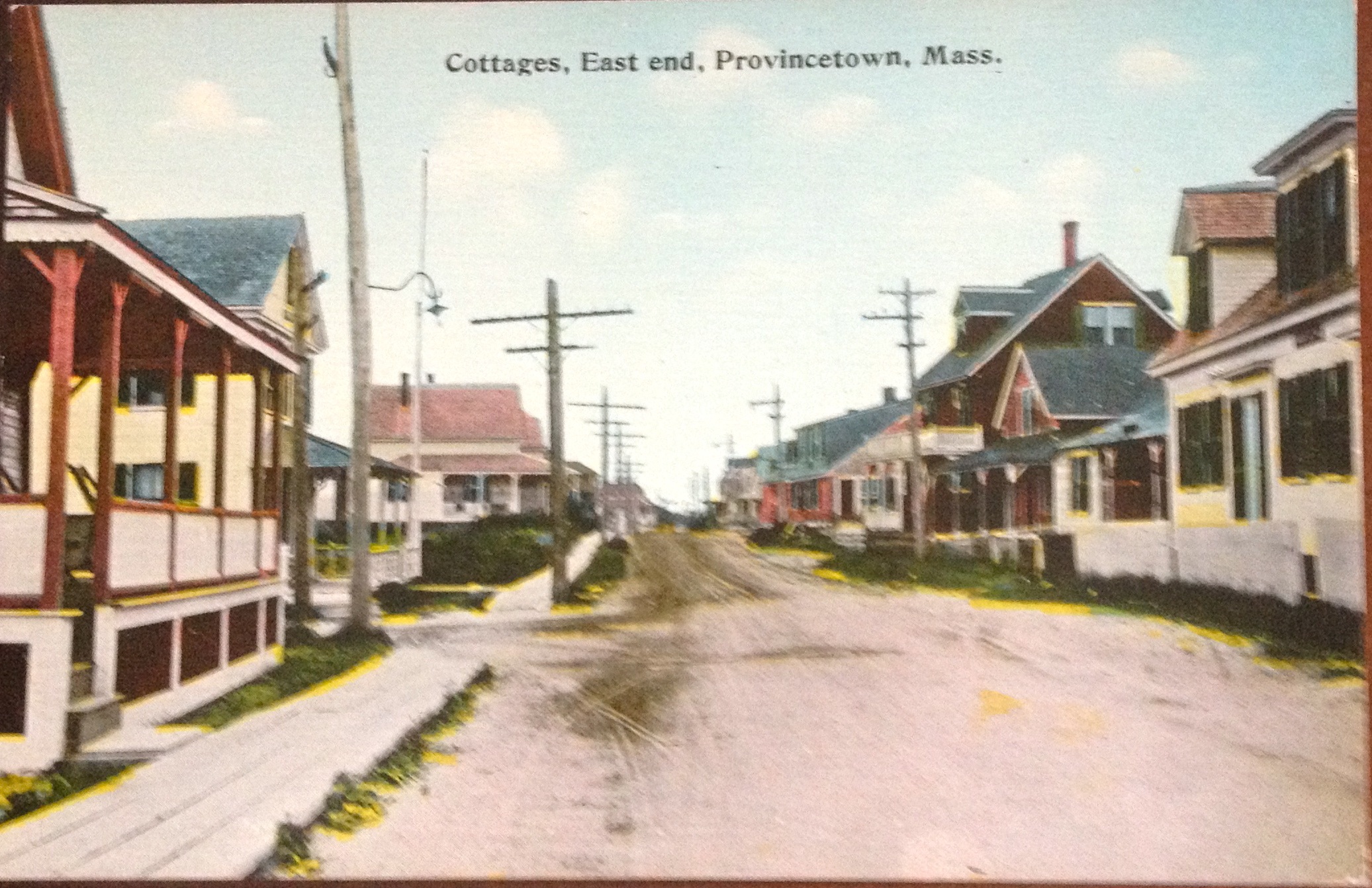
East End Cottages on Commercial Street in Provincetown, Massachusetts

East End Cottages on Commercial Street in Provincetown, Massachusetts

Provincetown’s Commercial Street is unpaved and the sidewalks are made of wood, but the houses look very much the same as they do today. in this antique postcard printed 100 years ago.

Every town has its East End and West End and Provincetown, with its  long and narrow in configuration, is no different. The East End on the waterside has traditionally been populated with seasonal summer residents.  Famous artists like Robert Motherwell and  Helen Frankenthaler constructed a grand residence on the  East End waterfront, but others of more modest means stayed in historic Cape Cod cottages.  Empty lots are few and far between, when waterfront land is so valuable, but take a walk at the start of town, at the point where Commercial Street and Bradford Street divide, and see many beautiful old homes, primarily built in the beginning of the 20th century. What kinds of houses do the characters in Remaining in Provincetown live in? Real estate speculation has played a major role in Cape Cod’s economic development and where there is money to be made there is often graft and corruption. Could that kind of corruption lead to murder? You’ll have to read the  book to find out. Now available at Amazon in trade paperback or on kindle as an ebook. Like us on Facebook and be entered to win a FREE book and thank you for all the positive feedback

Like our facebook fan page and you may be selected to receive a FREE advance cppy!

Like our facebook fan page and you may be selected to receive a FREE advance cppy!

Provincetown Inn mystery of the house on the hill

West End, Provincetown Cape Cod Massachussets first Murchison house

West End, Provincetown Cape Cod Massachusetts first Murchison house

Today a contemporary mansion, once the residence of  the famous psychologist Carl Murchison, sits high up looking out across Land’s End, hidden by an overgrown thicket of shrubs and trees across the street from the Provincetown Inn. But 100 years ago, as shown in the above picture postcard, a white Victorian style house sat on an open bluff and the Provincetown Inn was yet to be constructed. (They opened their doors in 1925).

Cranberry bogs and wetlands once were more apparent in this scenic spot on the very tip of Cape Cod and an open white fence created a boundary for the flower bed and green fields beyond. Sidewalks were made of wood.

So who was Carl Murchison and his wife Dorotea who built the current glass walled house that sits on the hill today?… The Murchisons moved to Provincetown in the mid 1930s from Worcester, Massachusetts where Carl was previously editor and publisher of the Clark University Press.  Chair of the psychology department at Clark University he edited over a dozen books which brought international recognition to the University but also created some controversy within some scientific circles as to his research practices and management of the psychology department.  In 1935 he founded the Journal of Psychology, which he published out of his own home. This newest enterprise created the ultimate clash leading to his exit from the University.  He did, however retain possession of all the Clark University Press journals he edited and he continued to publish his journals out of Provincetown.  A tragic fire in the spring of 1956 destroyed the original house, including many of his private papers. A new modern house designed by Walter Gropius’s firm, costing $300,000 (a princely sum at the time) replaced the earlier home but unfortunately Carl did not live very much longer to enjoy its beauty. ( It was named on of the best-designed homes at 1959 by Architectural Record magazine. )He died in 1961, after an 18 month illness, (For more details about Murchison’s life consult Portraits of Pioneers in Psychology, vol 2, edited by Kimble, Boneau & Wertheimer, and published by the American Psychological Association, 1996.) His wife lived in the house for another 20 years. If you like mysteries and you like Provincetown, you’ll want to read  the new novel Remaining in Provincetown, just released this month and available for sale at Amazon in trade paperback or kindle. Like our Facebook page and you may be selected to receive a FREE book.

Finback Whale watching in Provincetown Cape Cod

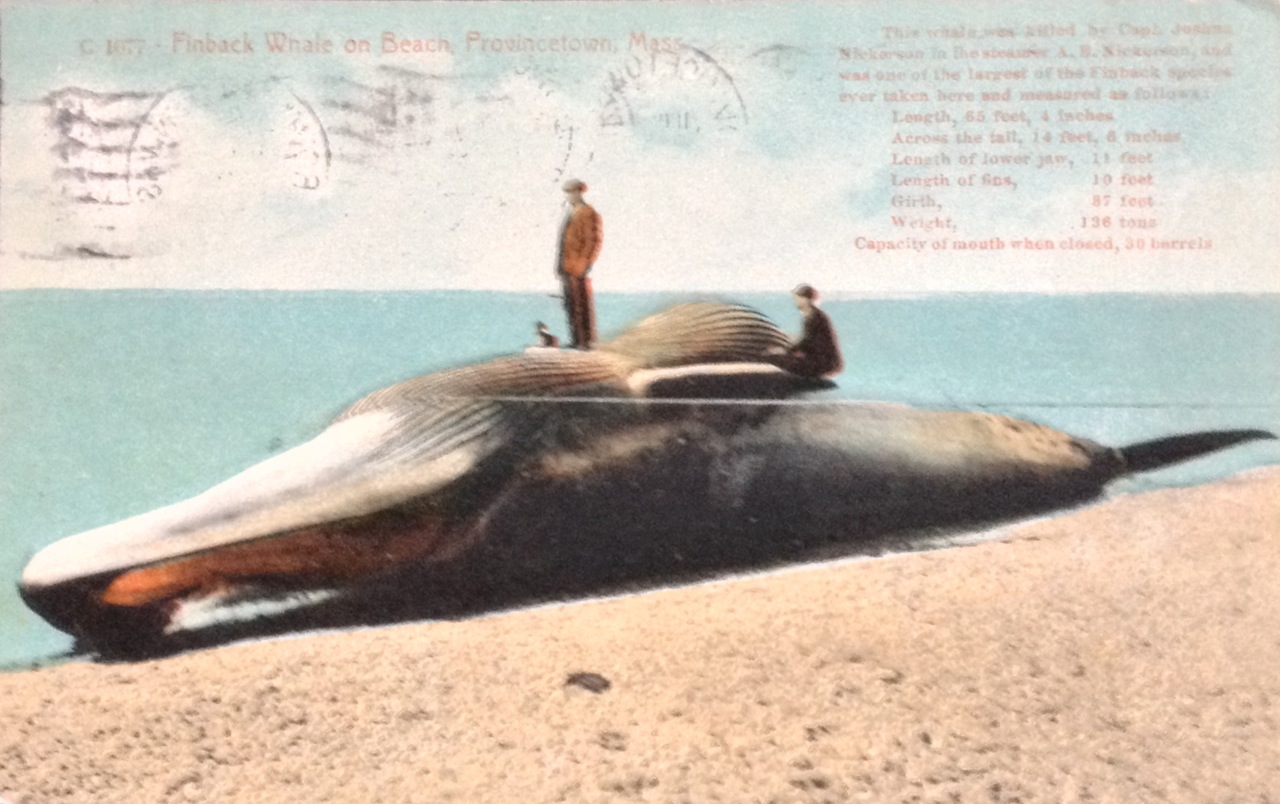
Finback Whale on Provincetown beach one of the largest ever taken.

Finback Whale on Provincetown beach one of the largest ever taken.

The Finback whale shown in this antique postcard which was mailed in 1918, at first glance looks as if it beached on the Provincetown shore. But on closer examination, and from reading the caption on the photograph, the sad truth is this whale was hunted and killed for its blubber oil.   Currently an endangered species, the Finback is the second largest animal in the world. (The Blue Whale is the largest) It has been described by naturalist Roy Chapman Andrews as “the greyhound of the sea”. Since the mid 1980’s whale watching has become a way for visitors to Cape Cod to observe these handsome mammals. Often sighted in the waters on the tip of Cape Cod are primarily Humpback Whales as well as a few Finback Whales.

This particular whale in the vintage postcard above was killed by Captain Joshua Nickerson while at the command of the steamer the A.B. Nickerson. It was one of the largest of the Finback species ever taken in Provincetown and measured 65 feet and 4 inches in length and weighed 136 tons.  According to the book Provincetown written by Herman Atwell Jennings, “in 1886 the steamer and a facility for processing whales was built at Herring Cove near the Race Point Lighthouse and in 1889 a wharf was extended from shore four hundred feet to enable the factory steamer to bring the whales and other fish alongside to be handled.” A number of the streets in Provincetown have the names of the early families that include Nickerson, Snow, and Dyer. Small towns have their secrets. Want to gain a more intimate sense of the town and its inhabitants?  You’ll want to read the new novel Remaining in Provincetown, now available at Amazon.com. Like us on Facebook and you may win a FREE copy.

Like our facebook fan page and you may be selected to receive a FREE advance cppy!

Like our facebook fan page and you may be selected to receive a FREE advance cppy!

Provincetown ferry to Boston living history

The Steamer Dorothy Bradford arriving in Provincetown in 1911

The Steamer Dorothy Bradford arriving in Provincetown in 1911

The “Boston Boat” has been a fixture in Provincetown culture since the first ferry boat connected the city of Boston to the furthermost tip of Cape Cod in 1883. The first boat was named The Longfellow and it was replaced in 1911 by the Dorothy Bradford shown above docking at Railroad Pier, now known as MacMillan Pier (named for the famous arctic explorer). Operated by the Cape Cod Steamship Company, the Dorothy Bradford was in service until 1937.  Today seasonal ferry service between Boston and Provincetown is provided by the Bay State Cruise Company. The Provincetown III makes it possible to get from Boston to Provincetown in just 90 minutes. The  2013 season begins on May 17th and will operate until mid October. For a lower price on Saturdays, visitors can take the Provincetown II for a lower price and a slower three hour journey. Either way, approaching Cape Cod by water provides beautiful scenery on a clear day.  And it’s the beautiful scenery and the proximity to water that has the characters in Remaining in Provincetown so committed to the town, despite its seasonal economic challenges. What is it like to live in the town when the “Boston Boat” is not running and tourists are few? You’ll have to read the book , now available at Amazon.com, to find out.

Old Cape Cod and Provincetown in stories and song

Vintage Cape Cod postcard circa 1930

Vintage Cape Cod postcard circa 1930

“If you’re fond of sand dunes and salty air,” goes the 1957 song written by Alan Jeffrey, Claire Rothrock and Milton Yakus, “Quaint little villages here and there, you’re sure to fall in love with  Old Cape Cod.” The hit tune sung by Patti Page captures the spirit of the above antique postcard published 20 some years earlier.  “If you like the taste of a lobster stew served by a window with an ocean view, you’re sure to fall in love with Old Cape Cod,” the song goes on to say although they don’t mention Provincetown’s Pilgrim Monument, fishing excursions, swimming, and little neck clams as illustrated in the postcard, the reference to “Old Cape Cod” alludes to the preponderance of historic buildings and antique shops even in the 1950s.  There are still plenty of antique shops, flea markets, and yard sales on Cape Cod today. And there were plenty of antiques bought and sold during the 1990s, when  the soon-to-be released mystery novel Remaining in Provincetown takes place. One of the book’s characters  Bruno, has furnished his entire Bed and Breakfast with antiques and another character, Sonny Carreiro, collects antique postcards. Visit our facebook page to see the novel’s front cover . Click the “like” button and you’ll automatically be entered to possibly win a FREE copy. Now available at Amazon.com.

Like our facebook fan page and you may be selected to receive a FREE advance cppy!

Like our facebook fan page and you may be selected to receive a FREE advance cppy!
Visiting the Sand Dunes in Provincetown, Cape Cod

Dune buggy Tour looking out over Pilgrim Lake

Dune buggy Tour looking out over Pilgrim Lake near Provincetown

Before there was a National Seashore, four wheel drive vehicles could traverse the sand dunes at the tip of Cape Cod, traveling back and forth to visit dune shacks and go fishing. Tourists would pull over to the side of the highway and get out of their cars to run up and down the dunes as they approached Provincetown. This postcard from the 1960s shows a Dune buggy tour on the sand dune above Pilgrim Lake, which you see as you approach Provincetown from Truro.  Initially the National Seashore built a parking lot near Pilgrim Lake to provide a safe spot for visitors to park but quickly realized all the erosion damage taking place and closed the area. Dune grass has been extensively planted to help prevent more loss of the dunes. In 1946 Art Costa started Art’s Dune  Tours and his son Bob Costa has continued the tradition of providing interesting educational tours that explain some of the historic highlights of the sand dunes that span from the back side of the town out to Race Point and the Outer Shore. You can walk the across the dunes by taking the path at Snail Road and hiking across the sand  or you can enjoy the bicycle trails that cross the sand dunes as the Carreiro children do in the soon-to-be released mystery novel Remaining in Provincetown.

Town Crier once a Provincetown tradition

Town Crier in Provincetown late 19th century

Town Crier in Provincetown late 19th century

Town Criers were once a New England tradition. Walking the streets they verbally spread the news and in tourist communities such as Provincetown on Cape Cod, they were often employed by the Chamber of Commerce to promote commerce.
Usually the image of a New England Town Crier is a plump man dressed in Pilgrim style garb. The Town Crier in the black and white postcard printed in Germany, shown above, carried the bell and the broadside, but is certainly not dressed like a pilgrim.  Through Provincetown’s history there  have been many different Town Criers, and they are documented in antique post cards.  The last Town Crier for Provincetown, Gene Poyant, walked the streets in the early 1980’s and died in 1998.  A Town Crier figures into the plot of the novel Remaining in Provincetown in more than one way, just as there are a variety of Town Criers. We’ll be sharing some more pictures of Town Criers from the past in the weeks to come.

Provincetown night life at the Pilgrim House

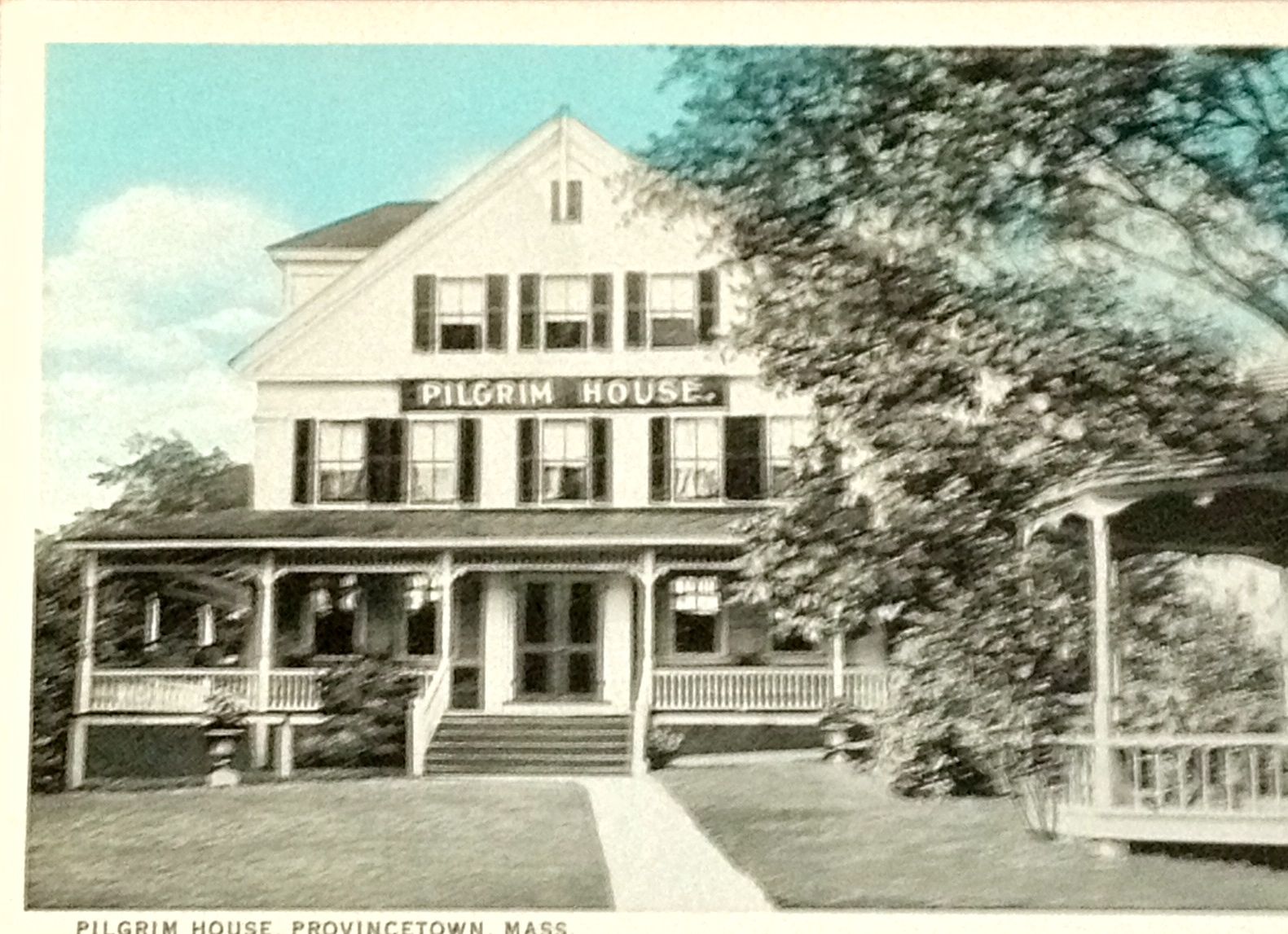
Pilgrim House, Provincetown Massachusetts built in 1781

Pilgrim House, Provincetown Massachusetts built in 1781

The night life in Provincetown includes many different types of entertainment including drag shows like the famous performances by Lynne Carter at the Pilgrim house during the 1960s.  After all, people are not always who they appear to be and looks can be deceiving. A favorite place to gather was the Madeira Club.  It didn’t matter what your sexual preference– gay, straight, or bi— everyone appreciated Lynne’s performances as Bette Davis.  In the mid 1970s Carter purchased the Club. Too bad that nothing can last forever. In 1990 the Pilgrim House was destroyed by arson. Hmm arson… A mysterious fire? Arson does figure into the plot of the soon-to-be released mystery novel Remaining in Provincetown. Keep following this site to find out exactly when the book will be available. We’ll also be giving away a few free copies and if you’d like to suggest sales outlets… let us know. Thank you!

Provincetown Bathing Beach a Tourist Attraction

Brown's Bathing Beach in Provincetown, Massachusetts

Brown’s Bathing Beach in Provincetown, Mass.

It was a time of discretion , when men and women covered themselves for the sake of modesty when bathing at a public beach. Brown’s Bathing Beach in Provincetown, was such a place where there were booths for changing into the appropriate bathing suits. Automobiles and trains enabled tourists to travel to scenic  beach side resorts such as  Provincetown, located on the tip of Cape Cod. It was a popular destination. With its narrow streets and houses built along the waterside, many guest houses and hotels established thriving businesses. Shops and restaurants geared to the tourist trade soon followed, creating a seasonal economy. Nowadays Provincetown is still a popular summer destination with a seasonal economy. It’s the winter economy that can be challenging for those who live on the Outer Cape year-round, Curious to know what it’s like in early spring before the tourist season? Read the  soon-to-be-released novel Remaining in Provincetown.